Snorkelling With Galapagos Sea Lions: What It's Actually Like
Juveniles are the curious ones, the two-metre rule still applies when the animal comes to you, and a shortie wetsuit matters more than you think from June to November. What snorkelling with Galapagos sea lions is really like, and which day boats deliver it.
 By Oleg Galeev, Galapagos travel writer, three trips to the islands
There is a sea lion who parks herself at the end of the fish market counter on the Puerto Ayora waterfront, between the pelicans, waiting for scraps. Nobody working there pays her the slightest attention. That was my introduction to Galapagos sea lions in 2021, standing on a pavement with a bag of bread, and it set the tone for everything that followed. These animals worked out a long time ago that humans are furniture.
Which explains the strange thing about day tours here. People book them for the boobies, the lava, the turquoise water. Then they come back talking about twenty minutes in the sea with a young sea lion that would not leave them alone.
What is snorkelling with a Galapagos sea lion actually like?
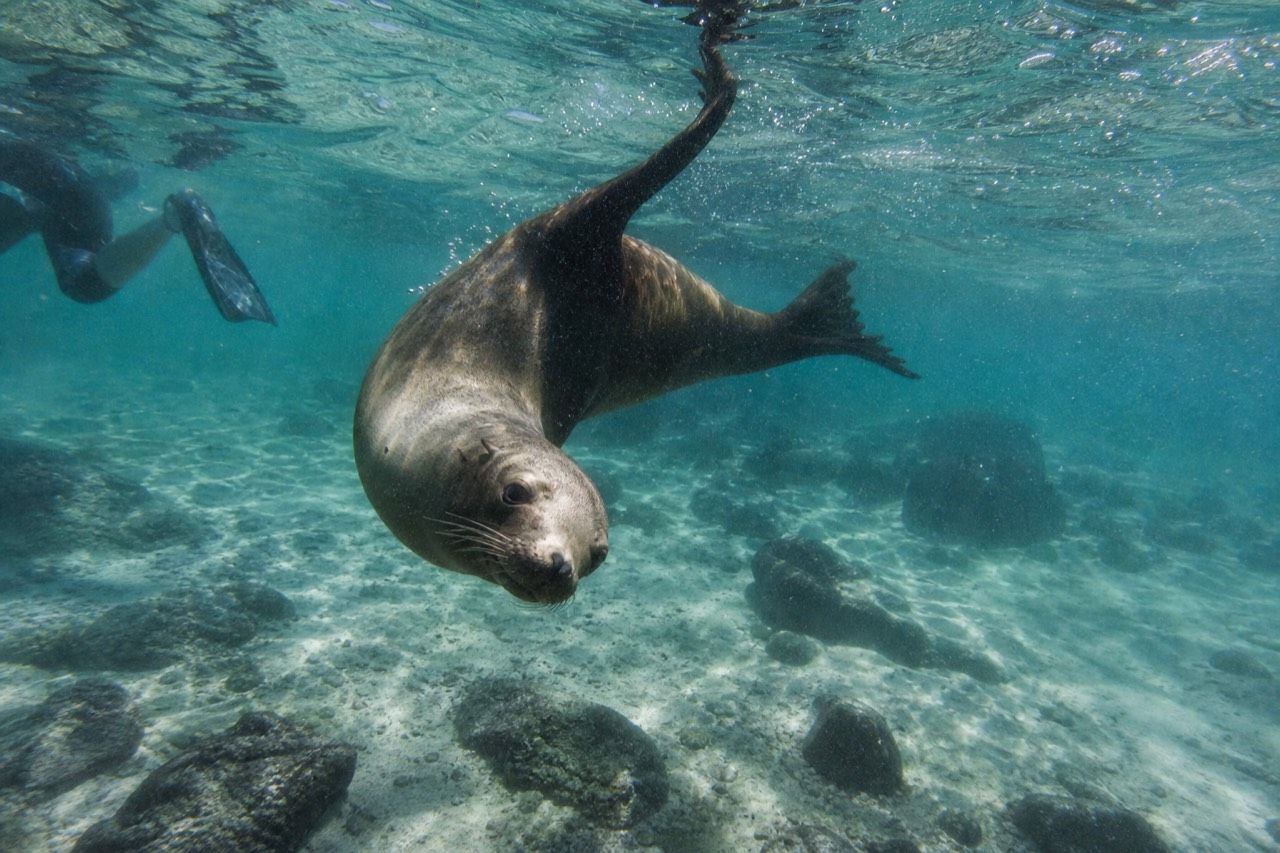
A juvenile usually finds you within a minute or two of entering the water near a colony. It swims loops around you, blows bubbles at your mask, hangs upside down at arm's length and copies whatever you do. It moves several times faster than you can, and it has no interest whatsoever in being touched.
Guides and reviewers describe the same sequence over and over. You slip off the panga, the group spreads out, and one animal peels off the rocks to investigate. It comes head-on and turns at the last moment. Then it is behind you. Somebody in the group starts spinning to keep track of it, which the sea lion reads as an invitation, and the whole thing escalates into a game only one participant is any good at.
The mirroring is the part nobody expects. Roll, and it rolls. Dive down two metres, and it drops past you and comes back up underneath. Stop moving entirely and it will often stop too, hovering vertically with its whiskers forward, watching. The Galapagos Conservation Trust's account of the species puts this in context: these are intensely social animals that spend their first years in a colony full of other juveniles, and play is how they practise everything they will need later.
Not every animal in a colony behaves this way, which is worth knowing before you get in and feel short-changed by an indifferent one.
| Who you meet | Typical behaviour in the water | What it means for you |
|---|---|---|
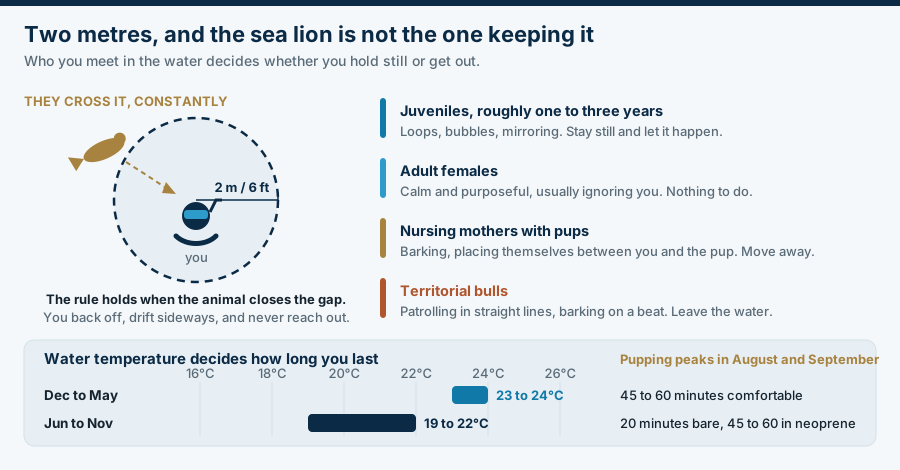
| Juveniles, roughly one to three years old | Fast, repetitive loops, bubble-blowing, mirroring, mock charges that break off | This is the encounter people describe. Stay still and let it happen |
| Adult females | Calm, purposeful swimming, often ignoring snorkellers entirely | Pleasant but undramatic. They are usually feeding or transiting |
| Nursing mothers with pups | Stay close to shore, bark, position themselves between pup and swimmer | Move away. A mother reads proximity as threat, not curiosity |
| Territorial bulls | Patrolling a stretch of shoreline, head-jerking, loud repetitive barking | Leave the water or move well down the beach. Not negotiable |
| Pups under a few months | On the sand, not in open water | Never approach on land. Handling means a mother may abandon it |
How does the two-metre rule work when the sea lion swims at you?
The park requires you to stay at least two metres, about six feet, from any wild animal, and the rule holds even when the animal closes the distance itself. Responsibility sits with you, not the sea lion. In practice that means you back off, drift sideways or stop and let it pass. You never reach out.
This is the single most misunderstood rule in the archipelago, and it comes up constantly in the water because sea lions break it deliberately and continuously. The official visitor rules are written on the assumption that wildlife here has no flight response, so the distance is a human obligation. A guide will tell the group this on the boat, and then tell it again when somebody starts filming a sea lion from thirty centimetres.
What that looks like when you are actually in the sea: keep your hands in against your body, do not chase, and if an animal parks itself in front of your mask, fin gently backwards rather than staying put. Touching risks disease transfer in both directions and can provoke a bite from an animal with a serious set of teeth. Guides also stop groups from using flash and from herding an animal against a rock wall, which is a subtler version of the same problem.
There is a conservation argument underneath the etiquette, and it is not decorative. Habituated colonies near towns already deal with dogs, boat traffic and fishing gear. Adding grabbing tourists to that list changes behaviour in ways that outlast your holiday. If you want the fuller picture of how the park manages visitor pressure, our notes on Galapagos eco tours go through what the licensing system actually controls.
Do you need a wetsuit, and when?
From June to November the sea sits around 19 to 22°C, cold enough that most people last twenty minutes without neoprene and an hour with it. From December to May it warms to roughly 23 to 24°C and a shortie is optional. Sea lion encounters reward patience, and patience is a function of how cold you are.
That is the practical reason the wetsuit matters. The animals show up when you stop thrashing and start hovering. If you are shivering and counting the minutes until the panga comes back, you cut the encounter short yourself. During the cool garúa season the water also carries the nutrient-rich Humboldt influence that brings the wildlife in, so the best months for activity are the coldest months to be in it.
Most reputable day operators include a wetsuit. Some offer a choice of shortie or full length, and a few include only mask and fins, which is the detail to check on the listing before you book rather than on the beach.
| Season | Months | Typical sea temperature | What most people wear | Comfortable time in water |
|---|---|---|---|---|
| Warm, wetter season | December to May | About 23 to 24°C | Shortie, or rash vest only | 45 to 60 minutes |
| Cool garúa season | June to November | About 19 to 22°C | Shortie minimum, full suit preferred | 20 minutes bare, 45 to 60 in neoprene |
| Shoulder weeks | Late May, late November | In between, changing week to week | Take the shortie regardless | Variable |
Our packing guide covers what to bring versus what to let the operator supply. The short version: bring your own mask if you have one that seals, because a leaking rental mask ruins more snorkelling here than cold water does.
Which day tours reliably deliver sea lions in the water?
Almost any boat that snorkels at a rocky shoreline near a colony will find them, but the reliable ones are the bay tours around Puerto Ayora, the Santa Fe and Pinzón boats from Santa Cruz, and anything working the San Cristóbal coast. Sea lion haul-outs are close to the three towns, which is why short tours often out-deliver long ones.
This runs against the instinct to book the biggest, longest, furthest trip available. Bartolomé is a spectacular landscape day and a long one, but the sea lion encounter is not its selling point. A three-hour bay loop from Puerto Ayora spends most of its water time exactly where the animals are.
If you have a spare half-day on Santa Cruz and want the highest ratio of sea lion time to cost, a bay tour is the answer: the half-day bay tour from Puerto Ayora runs about three hours with a guide and snorkel gear included, and you can check live availability & prices on Viator for your dates. It sits among the other options on our Santa Cruz day tours page if you want to compare against the full-day boats.
| Tour | Port | Duration | Wetsuit included | Rating |
|---|---|---|---|---|
| Half Day Bay Tour, Santa Cruz | Puerto Ayora | About 3 hours | Mask and fins only | 4.3 from 61 reviews |
| Santa Fe Island and hidden beach | Puerto Ayora | About 7 hours | Yes, short or long | 4.9 from 91 reviews |
| Pinzón Island day tour | Puerto Ayora | About 7 hours | Yes, short or long | 4.9 from 154 reviews |
| San Cristóbal 360 with Kicker Rock | Puerto Baquerizo Moreno | About 9 hours | Yes, with neoprene | 4.4 from 47 reviews |
| Kicker Rock full day plus beach | San Cristóbal pier | About 7 hours | Yes | 4.7 from 34 reviews |
When should you get out of the water?
When a bull starts patrolling, barking on a repeating beat, or swimming straight lines along a stretch of shore rather than loops around you. Territorial males defend a beach and the water in front of it during the breeding push, and they are large, fast and entirely serious about it.
The behavioural difference is easy to read once you know what you are looking at. A juvenile's approach is erratic and playful, all direction changes. A bull moves with intent. He will often surface repeatedly in the same line, head high, and the barking is not the yapping of a young animal but a low, insistent metronome. Guides pull groups out at that point without discussion, and if your guide does not, get out anyway.
Pupping peaks in August and September, which is also the middle of the cool season when snorkelling conditions are otherwise at their best. Beaches with young pups are the places to be most careful, both in and out of the water. On land the rule is the same two metres, and the reason is blunt: a pup that smells of human may be rejected.
| Where sea lions concentrate | Island | How you reach it | Character of the colony |
|---|---|---|---|
| Academy Bay rocky edges | Santa Cruz | Half-day bay boat from Puerto Ayora | Small groups, habituated, easy water |
| Tortuga Bay | Santa Cruz | Walk from Puerto Ayora, no boat needed | Resting animals on sand, plus marine iguanas |
| Santa Fe Island | Reached from Santa Cruz | Full-day boat, about 7 hours | One of the larger colonies on a day-boat route |
| Kicker Rock and Lobería | San Cristóbal | Day boat or short taxi from town | Big numbers, often in the water with snorkellers |
| Concha de Perla, Puerto Villamil | Isabela | Short walk from the pier | Sheltered lagoon, calm, good for nervous swimmers |
Are Galapagos sea lions dangerous?
Juveniles and females are not, provided you keep your distance and do not touch. Territorial bulls can be, especially in the breeding season. Bites happen almost exclusively when people crowd, chase or corner an animal.Can I snorkel with sea lions without booking a tour?
Yes, in a few places. Concha de Perla on Isabela and Lobería on San Cristóbal are shore-accessible. Most of the best sites sit inside protected areas where a licensed naturalist guide is required.Do I need to be a strong swimmer?
Not especially, but you should be comfortable in open water with a mask. Operators supply flotation vests on request, and sheltered sites like Concha de Perla are calm enough for beginners.What is the difference between a sea lion and a fur seal here?
Both are sea lions in the biological sense. The Galapagos fur seal is smaller, has a blunter face and denser coat, and prefers shaded rocky ledges. You are far less likely to meet one on a day tour.Is there a best month for sea lion encounters?
August and September put the most animals on the beaches because of pupping, and the water is clear. It is also the coldest stretch of the year, so take neoprene.The oddest part is how ordinary it feels afterwards. You get back on the boat, peel off a wetsuit, and somebody hands you a cup of coffee, and the thing that just happened would be a once-in-a-lifetime story anywhere else on the planet. Here it is Tuesday, and the same animal is already doing it to the next group.