Hiking Sierra Negra: The Cheapest Big Day in the Galapagos
Isabela's volcano holds one of the largest basaltic calderas on earth, around 10km across, and the guided hike costs roughly a third of a Santa Cruz boat day. What the trail is like, why the weather turns, and who should skip it.
 By Oleg Galeev, Galapagos travel writer, three trips to the islands
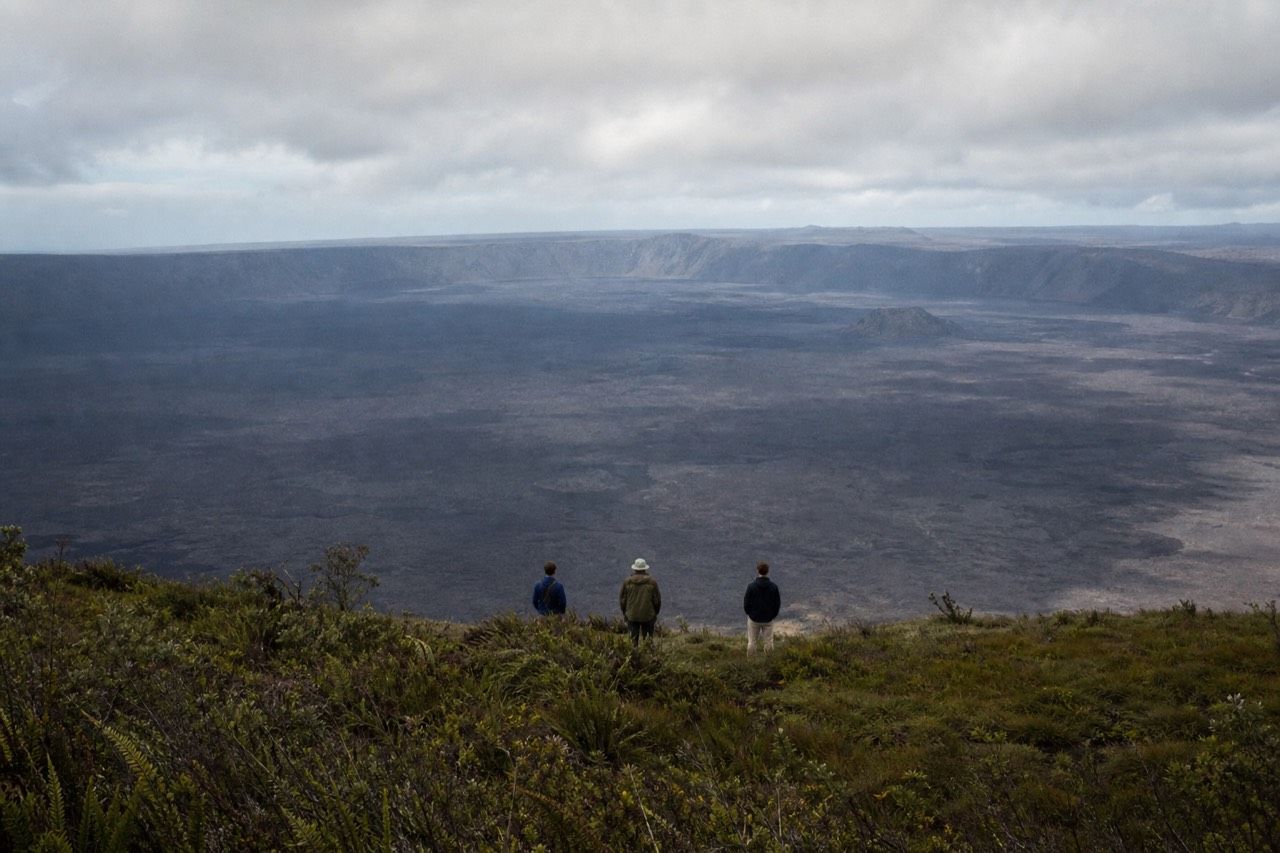
The Galapagos punishes budgets. Day boats from Santa Cruz run $145 to $245 per person, San Cristóbal trips reach $320, and that is before the $200 park fee, the $20 transit card and a flight. Then there is Sierra Negra, which costs somewhere around $65 to $77 depending on the operator and delivers a caldera roughly 10 kilometres across, one of the largest basaltic calderas anywhere on earth. I have not walked it: my own island time has been on Santa Cruz, and I am not going to pretend otherwise. What follows is drawn from operator listings, park information and what hikers consistently report about conditions.
What makes Sierra Negra worth a day?
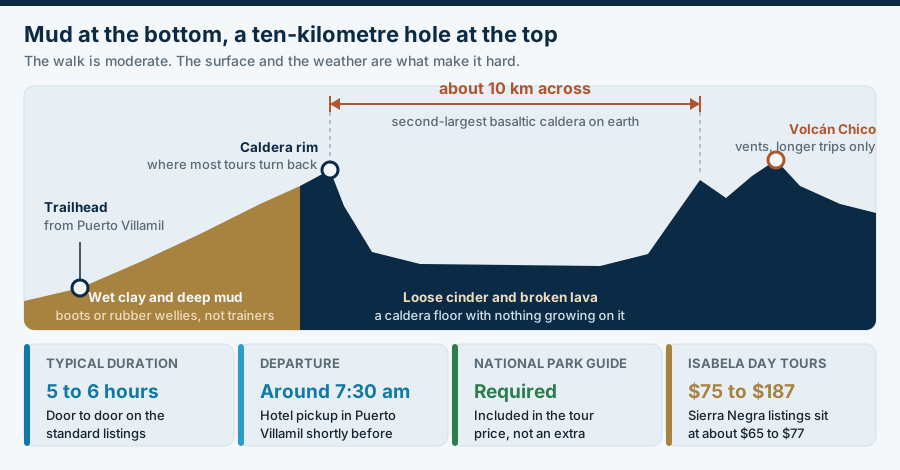
Sierra Negra is an active shield volcano on southern Isabela whose summit caldera measures about 10 kilometres across, the second-largest basaltic caldera in the world. The guided walk takes you to the rim and, on longer versions, along to the younger vents beyond it. The scale is the point.
Photographs undersell it badly, because a caldera that size has no visible edge in a frame. You arrive at the rim and the far wall is a hazy line several kilometres away, with a floor of black lava between, most of it laid down in eruptions recent enough that nothing has colonised it. The 2018 eruption fissures are part of what people walk to see.
The route starts inland from Puerto Villamil. Operators pick up from hotels early, drive up through the agricultural zone, and start walking from a trailhead where the vegetation is still green and dripping. That contrast is half the experience: you begin in wet highland scrub full of finches and end on a surface with no soil at all.
You cannot walk it alone. This is a protected visitor site, and the official park rules require a licensed naturalist guide, which is why every listing bundles one into the price rather than offering a cheaper self-guided option.
Volcán Chico, the cluster of younger vents on the northern flank, is where the colours are. Sulphur yellows, oxidised reds, fumarole steam. Not every operator includes it, and the shorter itineraries turn back at the rim, so check the description before assuming Chico is part of your day.
| Element | What the listings and park information show |
|---|---|
| Volcano type | Active basaltic shield volcano, southern Isabela |
| Caldera | Roughly 10 km across, second-largest basaltic caldera on earth |
| Trailhead | Inland from Puerto Villamil, reached by road through the farm zone |
| Typical departure | Around 7:30 am, with hotel pickup shortly before |
| Typical duration | 5 to 6 hours door to door on the standard listings |
| Guide | A national park guide is required, and is included in the tour price |
| Optional extension | Volcán Chico vents, on the longer itineraries only |
| Surface underfoot | Wet clay and mud at the start, loose lava and cinder higher up |
Why is it so much cheaper than everything else?
Because it has no boat. Every other headline Galapagos day involves fuel, a captain, a crew, marine park logistics and snorkelling equipment. Sierra Negra needs a van, a guide and a packed lunch, so it lands at roughly $65 to $77 while comparable-length boat days on Santa Cruz start at $145.
The economics are that simple, and they explain the whole pricing structure of the archipelago. Isabela day tours as a group run $75 to $187, the cheapest island to base yourself on for activities, while Santa Cruz sits at $145 to $245 and San Cristóbal at $149 to $320. Sierra Negra anchors the bottom of that range, and it is not a lesser experience for it.
Do the arithmetic per hour and the gap widens further. Five to six hours of guided walking for under $80 is the best value in the islands by a distance, and it leaves the afternoon free for Concha de Perla or the tortoise breeding centre, both walkable from Puerto Villamil for nothing.
| Island base | Typical day tour range | Example | What drives the cost |
|---|---|---|---|
| Isabela | $75 to $187 | Sierra Negra from about $77 | Land tours need no boat |
| Santa Cruz | $145 to $245 | Bartolomé around $245 | Long boat transfers, fuel, crew |
| San Cristóbal | $149 to $320 | Kicker Rock from about $160 | Marine sites only, all boat-based |
| Land-based island hopping | $250 to $350 per day | Hotels, tours and transport combined | Multi-island logistics |
| Cruise | $450 to $1,000+ per day | Week packages $3,000 to $10,000+ | Vessel, crew, permits, full board |
Our Galapagos tour cost guide breaks the full budget down, fees included, if you are building a total.
How hard is the walk, and how bad is the mud?
Physically it is moderate rather than demanding: a steady uphill on a wide track with no scrambling and no exposure. The difficulty is surface and weather. The lower trail runs through highland clay that turns to deep, slick mud after rain, which on Isabela is most of the year.
Hikers report the same thing consistently. The first stretch is the messy one, sticky orange mud that grabs at boots and makes the descent trickier than the climb. Trainers get destroyed. Some operators keep rubber boots to lend, which is worth asking about when you book, and several hikers simply buy cheap wellies in Puerto Villamil.
Higher up the surface changes to cinder and broken lava, which drains and is easier underfoot but reflects heat when the sun is out. Neither surface is technical. What catches people is doing five to six hours of it with the wrong shoes.
Altitude is not high enough to cause problems in itself, but it is high enough to make its own weather. The garúa mist that gives the cool season its name sits on the highlands, and a group can leave a sunny Puerto Villamil and arrive at a rim with visibility of thirty metres. It can also clear in ten minutes. Guides usually wait rather than turn around, which is one reason the listed duration has a range in it.
| Condition | Lower trail | Rim and Volcán Chico |
|---|---|---|
| Surface | Wet clay and mud, deeply rutted after rain | Loose cinder, broken lava, dry |
| Gradient | Steady uphill, no scrambling | Gentle undulation along the rim |
| Weather risk | Rain, humidity, biting insects | Cloud, wind, strong sun when it clears |
| Footwear | Boots or rubber wellies. Not trainers | Same, plus grip for loose stone |
| What you need | Rain layer, insect repellent | Sun hat, sunscreen, at least two litres of water |
Who should book it, and who should skip it?
Book it if you want landscape rather than wildlife, if you are on Isabela anyway, or if your budget will not stretch to another boat day. Skip it if you came for animals in the water, if you cannot manage five hours on uneven ground, or if you only have one day on Isabela and have not yet done Los Túneles.
That last case is the honest trade-off. Isabela's other headline day is the lava-arch snorkelling at Cabo Rosa, which delivers turtles, seahorses and white-tipped reef sharks. If you have exactly one day and you want animals, take the water. If you have two, do both, and put the volcano first while your legs are fresh.
Wildlife on the volcano itself is thin by Galapagos standards. Darwin's finches, Galapagos hawks if you are lucky, vermillion flycatchers in the highland scrub. Nobody books Sierra Negra for fauna, and a guide who oversells it is doing you no favours.
For a single big day on Isabela with a guide and transport included, the Sierra Negra volcano hike is the straightforward pick, and you can check live availability & prices on Viator for your dates. The listing shows a 4.3 rating across 24 reviews, modest numbers that reflect how little Galapagos business runs through international platforms rather than anything about the tour. Compare it against the water-based options on our Isabela day tours page before deciding.
| Suits you if | Skip it if |
|---|---|
| You want scale and geology over wildlife | You came primarily for marine animals |
| You are already staying in Puerto Villamil | You would need a ferry day each way to reach Isabela |
| Your budget is tight after flights and fees | You have one Isabela day and no snorkelling booked |
| You are comfortable walking 5 to 6 hours | Knees, hips or heat make long uneven walking hard |
| You accept a possible cloud-out at the rim | You need a guaranteed view for photographs |
Getting to Isabela is its own decision. There is no direct ferry from San Cristóbal, so you route through Santa Cruz, and the crossing runs 2 to 2.5 hours in a small speedboat that does not suit everybody. The Galapagos Conservancy's trip planning pages lay out the inter-island mechanics if you are building an itinerary around it.
Photographing the caldera is harder than it sounds, and a wide lens matters more than a long one. Our notes on Galapagos photography cover why, along with the midday light problem that affects every land tour here.
Do you need a guide for Sierra Negra?
Yes. It is a national park visitor site, and the park rules require a licensed naturalist guide at protected sites. The guide is included in the tour price.How fit do you need to be?
Moderately. There is no scrambling and no exposure, but you are on your feet for five to six hours on mud and loose lava. Regular walkers manage it comfortably.Can you do it independently?
No, not into the park section. You can reach the highlands by taxi, but the trail itself requires a guide, and going with an operator includes transport anyway.What happens if it is clouded in?
Guides generally continue and wait at the rim, since cloud often clears in minutes. Tours are not usually cancelled for mist. Nobody can promise you the view.Is Volcán Chico always included?
No. Shorter itineraries turn back at the rim. If the coloured vents and fumaroles are what you want, confirm Chico is on the route before booking.The reason to do it is not that it is cheap. It is that after several days of boats, wetsuits and animals that ignore you, standing at the edge of a hole ten kilometres wide with nothing living in it resets your sense of where you are. The islands are not a wildlife park. They are volcanoes that happen to have animals on them, and Sierra Negra is where that becomes obvious.