Photographing the Galapagos Without a Huge Lens
The two-metre rule puts wildlife closer than a telephoto can focus, drones are banned outright, and the boat schedule delivers you to every site in hard midday light. What actually works for photographs here, phone included.
 By Oleg Galeev, Galapagos travel writer, three trips to the islands
At Tortuga Bay in 2021 I spent twenty minutes trying to back far enough away from a marine iguana to fit it in the frame. It kept not moving, which is the whole problem in miniature. Everyone arrives here braced for the wildlife-photography experience they know from everywhere else, the long lens and the long wait, and then discovers the animals are sitting on the path. The gear that solves the Galapagos is almost the opposite of the gear people pack for it.
What lens do you actually need?
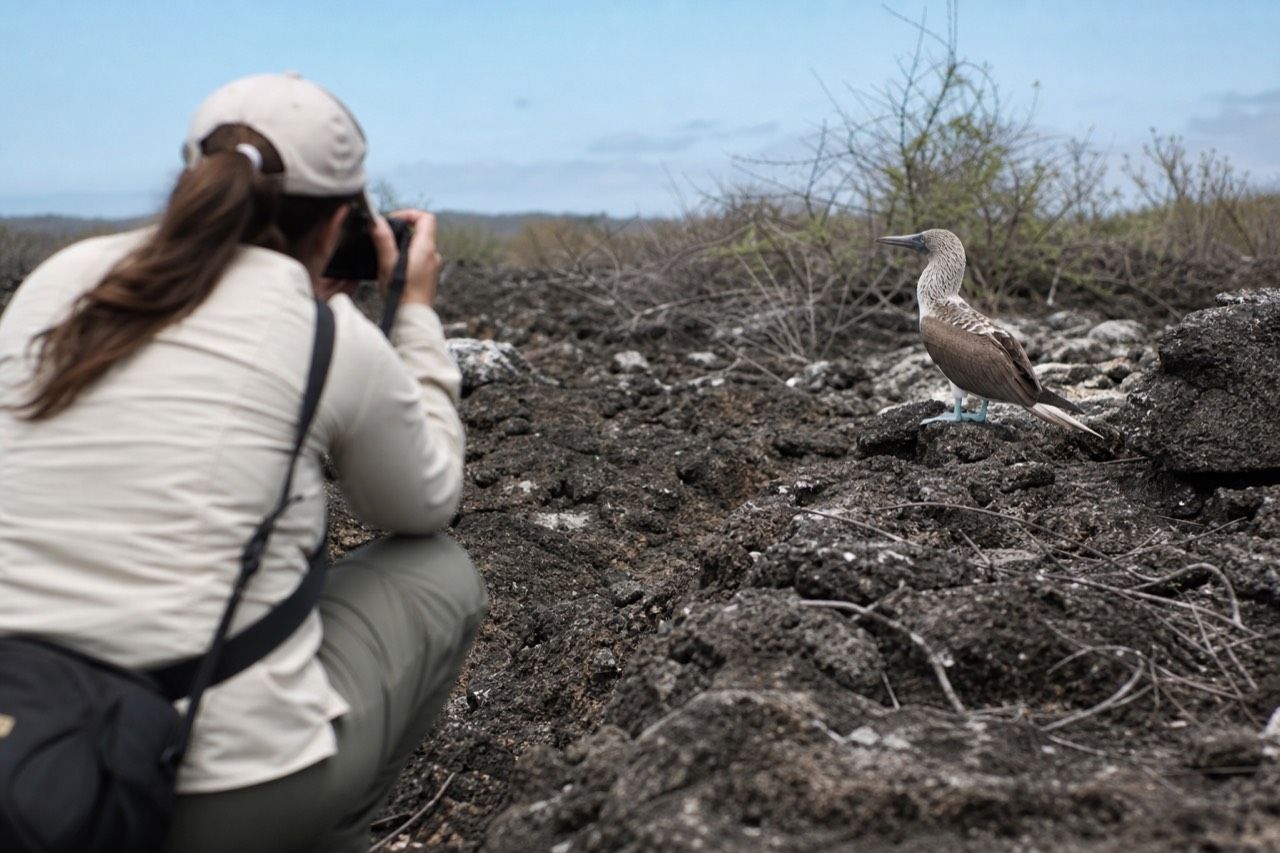
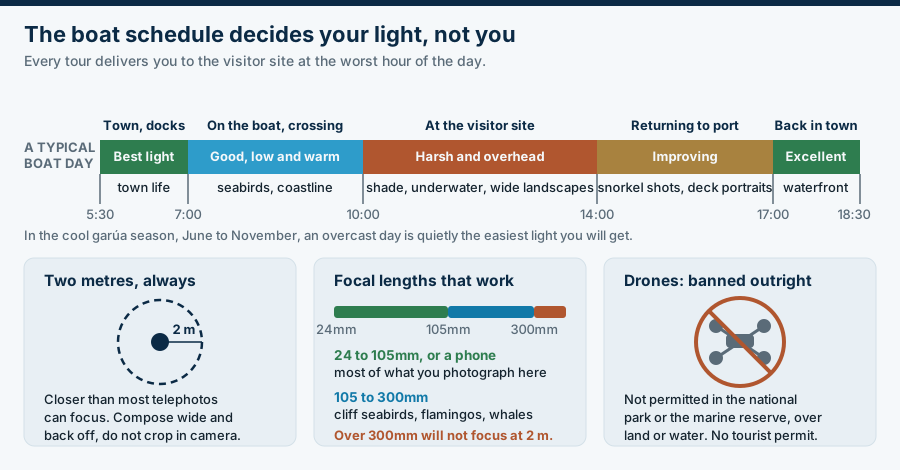
Something wide to normal, plus a modest zoom if you have one. The park requires two metres of distance from wildlife, and two metres is inside the minimum focus distance of most long telephotos. A phone, a kit zoom or a 24 to 105 covers the overwhelming majority of what you will photograph.
This is the single most useful thing to know before packing. A 400mm lens on a boat day gives you a bird filling the frame with no context, and it will not focus on the sea lion two metres from your knee. What the islands reward is the wide shot: an animal in its landscape, close enough to read expression, with the volcano or the surf behind it. That is a 24mm or 35mm picture, not a 400mm one.
Where reach genuinely helps is narrow: seabirds on cliff faces from a moving boat, flamingos across a lagoon, whales and dolphins. If you own a 70 to 200 or a superzoom bridge camera, bring it and expect to use it perhaps a fifth of the time. If you own nothing, a recent phone is not a compromise here in the way it would be on safari.
A second body is not worth the salt exposure. One camera, one versatile zoom, and your phone for everything you cannot be bothered to change lenses for.
| Subject | Typical distance | What works | What fails |
|---|---|---|---|
| Sea lions on a beach or dock | 2 to 3 metres | Phone, 24 to 35mm, wide zoom | Anything over 200mm, cannot focus |
| Marine iguanas | 2 metres, often less | Wide, low to the ground | Telephoto, no context in frame |
| Blue-footed boobies on a trail | 2 to 5 metres | 35 to 105mm | Long primes, too tight |
| Boobies and frigatebirds on cliffs | 30 metres plus, from a boat | 100 to 300mm, image stabilised | Wide lenses, subject becomes a speck |
| Flamingos in a lagoon | 50 metres plus | 200mm and up | Phone zoom, unusable |
| Giant tortoises in the highlands | 2 to 4 metres | Wide, or short zoom | Tripods, awkward on wet ground |
| Landscape, Pinnacle Rock and calderas | Kilometres | Wide, 16 to 35mm | Telephoto compression loses scale |
Why is the light so difficult, and what do you do about it?
Because the islands sit on the equator and the boat schedule puts you at visitor sites in the middle of the day. Tours leave around 7 or 8 in the morning, cross for an hour or more, and land you on a beach at 10 or 11 with the sun almost overhead. That is the worst light of the day and you cannot reschedule it.
Equatorial midday light is not merely bright, it is directly above you, which fills eye sockets with shadow and flattens everything else. On black lava with white sand nearby the contrast range is brutal, and phones tend to blow the sand out while cameras underexpose the rock.
The workarounds are unglamorous but they work. Shoot into shade wherever there is any, including the shadow of a boat or a cliff. Expose for the highlights and lift the shadows later, because sand recovers badly and lava recovers well. Turn the animal so the light rakes across it rather than down onto it, which usually means moving yourself, since the animal will not oblige. And take the mornings seriously: the hour before a tour leaves, in town, on the docks, is often the best light you will get all day.
| Time | Where you usually are | Light quality | What to shoot |
|---|---|---|---|
| 5:30 to 7:00 | Town, docks, hotel roof | The best light of the day | Sea lions on benches, pelicans, boats, town life |
| 7:00 to 9:00 | On the boat, crossing | Good, low and warm | Seabirds following the wake, coastline |
| 10:00 to 14:00 | At the visitor site | Harsh, overhead, high contrast | Shade, underwater, close detail, wide landscapes |
| 14:00 to 16:00 | Returning, second snorkel | Improving, still strong | Snorkelling shots, deck portraits |
| 17:00 to 18:30 | Back in town | Excellent, short window | Waterfront, iguanas on the road, sunset |
| After dark | Town | Street light only | Sea lions asleep on benches, long exposures |
In the cool garúa season, June to November, overcast days are common and are quietly a gift. Flat grey light on a beach full of animals is far easier to work with than direct sun, even if it makes for a duller sky.
Are drones allowed?
No. Drones and aerial tourism are not permitted in the Galapagos National Park or the Marine Reserve. There is no permit process for tourists, guides will stop you, and the ban applies over the water as well as over land. Leave it at home rather than risk confiscation.
People still arrive with them, usually having read a forum post from before the rules tightened. The official visitor rules are unambiguous, and the reasoning is straightforward: nesting seabirds and hauled-out marine mammals react badly to an object moving above them, and a colony flushed off its nests loses eggs to frigatebirds within minutes.
The same page carries the two-metre distance rule that shapes every photograph you will take here. It applies when the animal approaches you, which sea lions and mockingbirds do constantly, and the responsibility sits with you to move. Practically, that means composing for the distance you are allowed rather than creeping forward for a tighter frame.
| Rule | What it means for photographers |
|---|---|
| Drones and aerial tourism banned in park and marine reserve | No aerial footage at all, no exceptions for tourists |
| Minimum two metres from wildlife, including when it approaches | Compose wide, back off rather than crop in camera |
| Licensed naturalist guide required at protected sites | You move with the group, not on your own schedule |
| Stay on marked trails | No repositioning for a better angle off-path |
| Do not touch, feed or handle animals | Rules out every staged shot people ask about |
How do you protect gear from salt, and get usable underwater shots?
Salt spray on a panga is constant and it kills cameras slowly. Carry a dry bag, not a camera bag, and wipe the front element with fresh water at the end of each day. For underwater, an action camera or a phone in a proper housing beats nothing, and getting close matters more than any setting.
The wet moments are the transfers. Panga rides in chop soak everything in the bow, and a rucksack is not waterproof no matter what the tag says. A cheap roll-top dry bag with the camera inside a second bag is enough, and the point is to close it before you get in the boat rather than after the first wave.
Underwater the physics are simple and unforgiving. Water eats red first, then orange, so anything more than about a metre away goes blue and flat. The fix is not a filter or a preset, it is distance: get close, shoot slightly upwards towards the light, and shoot far more frames than you think you need because you cannot see the screen properly through a mask. Sea lions make this easy by coming to you. The piece on snorkelling with sea lions explains why the juveniles will do half your composition for you.
Snorkelling from a boat also means salt water and a wetsuit and no dry hands, so a wrist strap or a float on any handheld camera is not optional. Kicker Rock is an especially easy place to lose one, since the water is deep and the current moves. Our Kicker Rock guide covers the conditions there in more detail.
| Item | Why it matters | Cheap alternative |
|---|---|---|
| Roll-top dry bag | Panga transfers soak everything | Two heavy-duty zip bags inside a rucksack |
| Microfibre cloths, several | Salt film forms fast on the front element | Any clean cotton, changed daily |
| Fresh water rinse for housings | Salt crystals wreck seals | Hotel bathroom sink, five minutes |
| Wrist strap or float | Deep water, cold hands, wetsuit gloves | Cord and a pool noodle offcut |
| Spare battery | No charging on a ten-hour boat day | Shoot fewer bursts, turn the screen off |
| Lens cloth for phones | Sunscreen smears are the top phone problem | Rinse hands before shooting |
Our packing guide covers the rest of the kit list, including what the operators supply so you do not carry it twice.
Which day tour gives you the best photographs?
For landscape, Bartolomé, without much competition. The climb to the viewpoint delivers the Pinnacle Rock panorama that appears on most Galapagos book covers, and it is a wide-lens day rather than a wildlife-lens day. For animals close up, the shorter Santa Cruz boats and the San Cristóbal coast do better.
Choose by what you want to come home with. Bartolomé is a ten-hour day, mostly at sea, ending in one of the archipelago's genuinely iconic views. That view is also the reason to accept the midday light: you have no choice about arrival time, so shoot wide, include the boardwalk for scale, and come back down for the snorkel.
If the landscape shot is the one you want, the Bartolomé Island full-day tour is the trip that gets you there, with a guide and lunch included, and you can check live availability & prices on Viator, where the price shows in the booking flow. The listing carries a 4.8 rating from 21 reviews, a small sample that reflects how little Galapagos business runs through international platforms. It sits alongside the shorter, animal-heavy options on our Santa Cruz day tours page, and the Conservancy's trip planning pages are worth a look if you are still deciding which sites your itinerary can physically reach.
Can I take a phone-only trip and be happy with the results?
Yes, more than anywhere else. The two-metre rule means most subjects are within a phone's comfortable range, and recent phones handle the high-contrast beach light better than they used to.Is a tripod worth carrying?
Rarely. You are on wet boats, marked trails and a group schedule, and there is almost no low-light shooting. A small tabletop tripod for town sunsets is as far as it is worth going.Can I use flash on wildlife?
Guides discourage it and you should not need it. At two metres in equatorial daylight, fill from a reflector or simply repositioning yourself does the job without startling anything.What about a GoPro instead of an underwater housing?
Fine for snorkelling, and the wide field of view suits sea lions and turtles that come close. Add a float and a wrist strap, since deep water and cold hands lose a lot of them.Do I need to declare camera gear at the biosecurity check?
No. The inspection targets food, seeds, plants and animal products, not equipment. Do brush sand and soil off bags and boots between islands, which is what the checks at the inter-island piers are looking for.The picture I still use from that first trip is the marine iguana, shot on a phone from about waist height, with Tortuga Bay's surf out of focus behind it. No long lens would have made it better. That is the useful lesson here, and it saves several kilos of luggage.