Kicker Rock (León Dormido): Everything Before You Go
The eroded tuff cone off San Cristóbal, the channel between the two rocks, hammerheads and Galapagos sharks, why snorkellers get in easily and divers need experience, and honest expectations about visibility by season.
 By Oleg Galeev, Galapagos travel writer, three trips to the islands
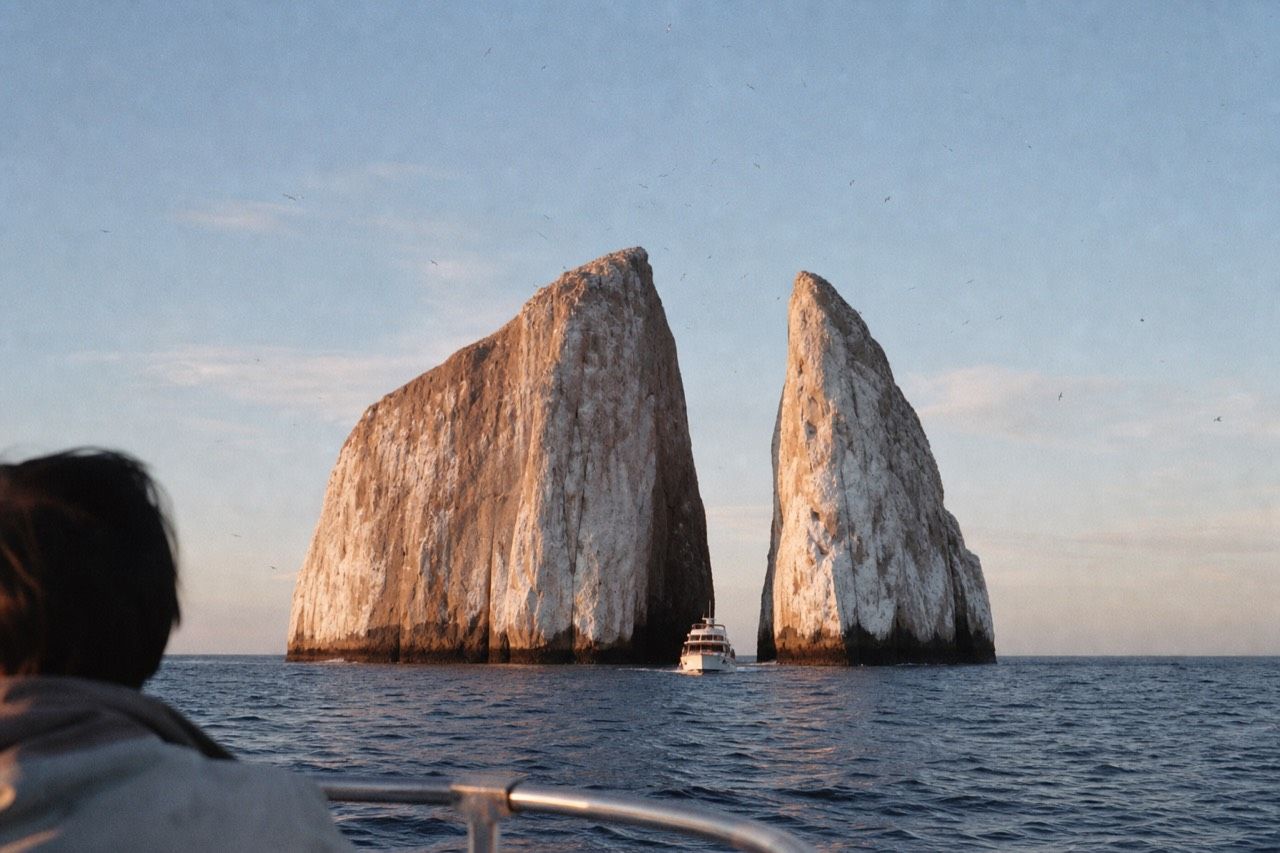
Kicker Rock turns up in more Galapagos tour listings than almost any other single site. I noticed that while cataloguing options for my cruise platform: day boats, dive boats, half-day boats, boats that call it León Dormido and boats that call it Kicker Rock, all selling essentially the same two hours in the same patch of water. That volume tells you something real. It also hides a fact the marketing photographs never mention, which is that what you see there swings hard with the season.
What exactly is Kicker Rock?
It is the eroded remains of a tuff cone, a volcanic vent built from compacted ash, rising roughly 140 metres straight out of the ocean about an hour by boat off the coast of San Cristóbal. Erosion split it into two formations separated by a narrow channel, and that channel is the reason anybody goes.
The Spanish name, León Dormido, means sleeping lion, and from certain angles the profile does read that way. The English name comes from a different resemblance entirely. Neither name tells you much about the geology, which is more interesting than either: this is not a lava dome or a plug of hard basalt, it is consolidated ash from an explosive eruption where magma hit water. That material erodes unevenly, which is how you get vertical walls on one face and crumbling slopes on another.
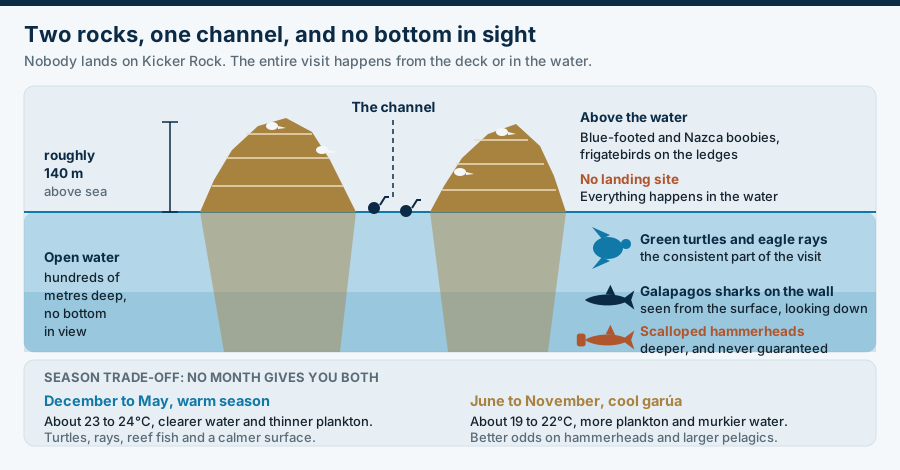
Nothing grows on it worth the name. Seabirds nest on the ledges instead, and from the boat you will usually pick out blue-footed boobies, Nazca boobies and frigatebirds on the upper faces before you have your mask on. Nobody lands on the rock. There is no landing site and no trail, so the entire visit happens from the water or from the deck.
The channel between the two formations is the main event. It is a narrow, sheer-walled gap with open ocean at both ends, which funnels current and concentrates fish, and it is where guides take snorkelling groups when conditions allow.
| Feature | Detail |
|---|---|
| Formation type | Eroded tuff cone, consolidated volcanic ash |
| Height above sea | Roughly 140 metres |
| Structure | Two formations split by a narrow vertical channel |
| Location | Off the coast of San Cristóbal, north of Puerto Baquerizo Moreno |
| Boat time from port | Operators typically schedule 45 minutes to an hour each way |
| Landing | None. No trail, no shore access, water and deck only |
| Guide | A licensed naturalist guide is required, as at every protected site |
| Above-water wildlife | Blue-footed and Nazca boobies, frigatebirds, tropicbirds |
Can you really snorkel with hammerheads there?
Yes, and this is the site's whole reputation. Scalloped hammerheads school in the deeper water below the channel, and Galapagos sharks and blacktips patrol closer to the walls. You see them from the surface, looking down through open water, not by descending. Nothing is guaranteed on any given day.
That last sentence is the one operators soften and this site will not. Hammerheads are pelagic, they move, and a boat that found forty of them yesterday can find none today. What is far more consistent is everything else: green turtles, eagle rays, large schools of black-striped salema, sea lions, and often a Galapagos shark cruising the wall in plain sight. Reviewers who went in expecting a shark documentary sometimes come out disappointed. Reviewers who went in expecting a wall of fish and a chance of sharks come out delighted.
The physical experience catches people off guard. You are floating over water hundreds of metres deep with no bottom in view, which is a different sensation from snorkelling over a reef, and a few people in every group find it genuinely unnerving. Guides bring flotation vests for exactly this reason and there is no shame in using one.
The rock sits inside the Galapagos Marine Reserve, which grew substantially when Ecuador announced the Hermandad expansion in January 2022, adding 60,000 km² along the migratory corridor these sharks use.
Sharks here are not interested in snorkellers. Galapagos sharks are large and can look confrontational, but incidents involving snorkelling groups at this site are not a feature of the record. The rules that apply everywhere else in the park apply here too: the official park rules require two metres of distance from any animal, which in open water mostly means not swimming down towards anything.
If you want the broader picture of what is in the water across the archipelago, our piece on snorkelling with sea lions covers the encounter most people actually remember from a day boat.
Why is snorkelling easy here but diving advanced?
Snorkelling needs only that you can float and breathe through a tube, and the guide manages the drift for you. Diving at Kicker Rock means depth, current and open blue water with no reference points. Ecuadorian dive operators generally set an experience minimum, and this is not a site for your first ocean dives.
The difference comes down to what happens when the current turns on. On the surface, a drift through the channel is a controlled ride: the panga follows the group, you go where the water goes, and you get picked up at the far end. Below, the same current at depth demands buoyancy control, gas management and the composure to handle being swept away from a wall you were using for orientation. Add the temperature swing during the cool season and you have a dive that punishes inexperience.
I have no diving qualification, so on this point I am reporting rather than advising: operator listings for the certified-diver trips at this site require a current certification, and several also ask about logged dives and recent experience. Read the requirements on the listing rather than assuming your open-water card is enough.
| Snorkelling | Diving | |
|---|---|---|
| Who it suits | Anyone comfortable in open water with a mask | Certified divers with recent logged dives |
| Typical requirement | None. Flotation vests available | Certification card, logged-dive minimum, often a recent-dive rule |
| What you see | Turtles, rays, salema schools, sea lions, sharks from above | The same, plus wall life and closer shark passes |
| Main difficulty | Depth perception over open blue water | Current at depth, buoyancy, no visual reference |
| Time in the water | Usually two entries of 30 to 45 minutes | Two dives, with a surface interval |
| Available on a day boat | Yes, on most San Cristóbal itineraries | Yes, but on dedicated dive boats |
Our Galapagos diving guide sets out how the certified-diver day trips work and where Kicker Rock sits against the bigger northern sites.
When is visibility best, and what changes by season?
Visibility is generally clearer in the warm season from December to May, when the water sits around 23 to 24°C and plankton is thinner. The cool garúa season, June to November, brings colder water at 19 to 22°C, more plankton and often murkier conditions, but that same nutrient load is what pulls in the big animals.
This is the trade-off nobody explains at the booking stage. Warm-season snorkellers get postcard water and fewer sharks. Cool-season snorkellers get green, particle-heavy water and better odds on hammerheads. There is no month that gives you both, and any operator promising crystal visibility plus guaranteed schooling sharks is selling you something.
Surface conditions matter as much as clarity. In the garúa months the channel can be choppy enough that guides move the group to the sheltered side of the rock or skip the channel drift entirely. That call gets made on the day, on the water, and it is not a sign of a bad operator. The reverse is also true: a calm channel on a clear morning is one of the best hours of snorkelling anywhere in the islands.
| Season | Months | Sea temperature | Typical visibility | What tends to show up |
|---|---|---|---|---|
| Warm, wetter | December to May | About 23 to 24°C | Generally clearer | Turtles, rays, reef fish, calmer surface |
| Cool garúa | June to November | About 19 to 22°C | Often reduced by plankton | Better odds on hammerheads and larger pelagics |
| Transition weeks | Late May, late November | Shifting | Unpredictable | Mixed. Book flexible dates if you can |
For choosing dates around wildlife more broadly, the best time to visit breaks the year down month by month.
Which Kicker Rock tour should you book?
Two formats dominate. The full-day 360 circumnavigation of San Cristóbal builds the whole island coastline around a Kicker Rock stop and runs about nine hours. The shorter Kicker Rock plus beach day runs about seven and pairs the rock with a landing beach. Both include a guide, wetsuit and lunch.
Which one suits you depends on how much boat you want. The 360 gives you the full circuit, more coastline, more seabird cliffs and a longer day at sea, which is a real consideration if anyone in your group gets seasick. The shorter format gets you the same channel snorkel and swaps the second half for time ashore.
If you want the whole island in one shot and Kicker Rock as the centrepiece, the San Cristóbal 360 tour is the one to look at first, and you can check live availability & prices on Viator before you commit. Both formats and the rest of the island's options sit on our San Cristóbal day tours page.
| Tour | Platform | Duration | Listed price | Cancellation | Rating |
|---|---|---|---|---|---|
| San Cristóbal 360 with Kicker Rock | Viator | About 9 hours | From $270 | Non-refundable | 4.4 from 47 reviews |
| Kicker Rock full day plus beach | GetYourGuide | About 7 hours | $260 per person | Free up to 24 hours before | 4.7 from 34 reviews |
Review counts on both platforms are modest, because most Galapagos travel still gets booked direct with local operators rather than through international marketplaces. Read the ratings as a signal, not a verdict.
Do you need to be a strong swimmer for Kicker Rock?
You need to be comfortable in deep open water with a mask. Operators carry flotation vests and guides stay with the group, but this is not a shallow lagoon and the sensation of no visible bottom bothers some people.Are hammerheads guaranteed?
No. They school in the area and are seen regularly, particularly in the cool season, but they move constantly. Treat any sighting as a bonus on top of turtles, rays and fish schools.Can you visit Kicker Rock from Santa Cruz?
Not on a normal day trip. It sits off San Cristóbal, and the ferry from Santa Cruz takes 2 to 2.5 hours each way, so you would need at least a night in Puerto Baquerizo Moreno.Is there anywhere to land on the rock?
No. There is no visitor trail and no landing site. Everything happens from the boat or in the water.Do the tours include a wetsuit?
The main day boats do, along with mask, fins and lunch. Check the inclusions on the listing, since a few cheaper trips supply mask and fins only, which is a problem from June to November.The thing to hold on to is that Kicker Rock is a lottery with very good odds on the consolation prizes. You may not get the hammerhead wall from the brochure. You will almost certainly get turtles at arm's length, a shark somewhere below you, and a wall of silver fish thick enough to blot out the light, which is not a bad afternoon in anybody's accounting.