Doing the Galapagos Solo: Cost, Safety and Whether It's Lonely
Shared day boats make land-based Galapagos travel social by default, while cruise single supplements punish solo travellers hard. Real costs for one person, the safety picture in the three towns, and how to structure a solo week.
 By Oleg Galeev, Galapagos travel writer, three trips to the islands
I booked my 2023 Galapagos cruise at the last minute, which is the standard advice given to solo travellers and also the reason the whole cruise model works badly for them. Cabins are sold by the bed, but priced by the pair. Turn up alone and you either pay a supplement for the empty half or accept a stranger, and while cataloguing hundreds of these itineraries for my platform I watched that single line item quietly attach most of a second fare to otherwise reasonable trips. The land-based alternative does not do this at all, which is the single most useful thing a solo traveller can know before booking anything here.
Is the Galapagos expensive if you are travelling alone?
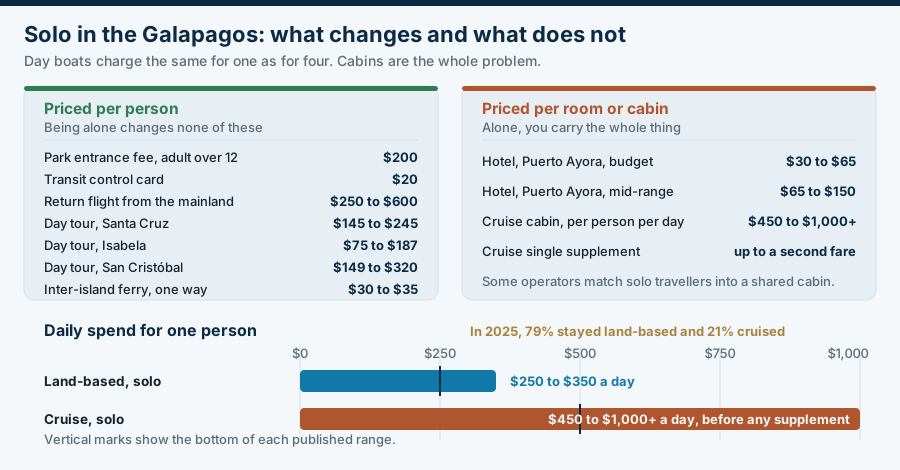
The fixed costs are identical whether you come alone or with five people: $200 park fee, $20 transit card, $250 to $600 for flights. What changes is accommodation and cabins. Land-based travel penalises solo travellers only on the hotel room, and day tours are priced per person regardless.
That is why the land-based route works out so much better. A shared day boat charges the same $145 to $245 per seat whether you booked one or four. Nobody adds a surcharge for the empty seat beside you, because there is no empty seat, somebody else is in it. The only place you eat the cost of being one person is the hotel, and even that is softened by hostels and guesthouses in all three towns.
Set that against a cruise, where the vessel sells cabins and an unshared cabin means paying for both berths. Some operators will place you with a same-sex roommate at no supplement, which solves the money problem and creates a different one if you value privacy. Others charge between a modest premium and the full second fare.
| Cost item | What one person pays | Does going solo change it? |
|---|---|---|
| Park entrance fee | $200, adults over 12 | No |
| Transit control card | $20 | No |
| Return flight from Quito or Guayaquil | $250 to $600 | No |
| Day tour, Santa Cruz | $145 to $245 | No, priced per person |
| Day tour, Isabela | $75 to $187 | No |
| Day tour, San Cristóbal | $149 to $320 | No |
| Inter-island ferry | $30 to $35 one way | No |
| Hotel, Puerto Ayora | $30 to $65 budget, $65 to $150 mid-range | Yes, you carry the whole room |
| Cruise cabin | $450 to $1,000+ per day | Yes, and hardest of all |
Our cost guide builds the full budget out, and the cruise versus land-based comparison goes deeper into where the two models diverge.
Does the single supplement really make cruises that much worse?
Yes, and it is the reason 79% of Galapagos visitors now stay land-based. A cruise berth already runs $450 to $1,000 or more per person per day. Add a supplement for the second bed you are not using and a week can climb by a four-figure sum for no additional experience.
There are three ways operators handle it, and they are worth asking about explicitly rather than reading between lines. Some run a share-a-cabin matching programme, pairing you with another solo traveller of the same sex. Some waive the supplement on selected departures to fill boats. Some charge a percentage on top, which is where the damage happens.
Last-minute booking from Quito or Puerto Ayora is the classic workaround, and it does work, but it comes with real risk. You need flexible dates, a tolerance for whatever itinerary is left, and the willingness to lose days waiting. That is a fine strategy for a traveller with three spare weeks and a poor one for someone with ten days of leave.
Land-based travel sidesteps the entire question. You book a room, you book day boats, and the pricing never asks how many of you there are.
| Land-based, solo | Cruise, solo | |
|---|---|---|
| Extra cost for being alone | Hotel room only | Single supplement, often substantial |
| Daily spend | $250 to $350 typical | $450 to $1,000+ |
| Social contact | Different group every day | Same group all week |
| Flexibility | Change plans daily | Fixed itinerary |
| Sites reached | Day-boat sites near the three towns | Remote islands, Genovesa, Española, Fernandina |
| Booking risk | Low, book as you go | Higher, best deals are last minute |
Is it lonely?
Not on a day boat. Shared tours run with small mixed groups, you spend seven hours together, you snorkel together and you eat lunch on deck together, and the pattern in Puerto Ayora is that people who met on a boat that morning are having dinner together that evening. The islands are unusually easy to travel alone.
The structure does the work for you. Everyone on the boat is in the same position: new here, no phone signal, in a wetsuit, watching the same turtle. Conversation happens without anyone having to be good at starting it. Then the boat returns to the same small waterfront, where there are perhaps a dozen places to eat, and you keep bumping into the same faces.
The offline stretch actually helps. With no signal at sea, nobody spends the crossing on a phone, and the default becomes talking. Our notes on connectivity in the islands cover what that means practically, including how long each tour leaves you unreachable.
If you want the most sociable single day boat, take one where the snorkelling is the centrepiece and the group is small. A seven-hour trip to Santa Fe Island and the hidden beach fits that shape, with wetsuit, lunch and gear included, and it holds a 4.9 rating across 91 reviews, which is a decent signal on a platform where Galapagos review volumes stay low. You can check live availability & prices on Viator, where the price appears in the booking flow. Compare it with the rest on our Santa Cruz day tours page.
The exception is the evening on Isabela. Puerto Villamil is small, quiet and closes early, and a solo traveller who wanted nightlife will not find much. Puerto Ayora is the sociable base by a distance.
How safe is the Galapagos for a solo traveller?
The United States State Department rates Ecuador Level 2, Exercise Increased Caution, which covers the whole country including the islands. The Galapagos towns are small, heavily dependent on tourism and policed accordingly. Normal precautions apply: watch your bag, avoid unlit areas late, do not leave gear on beaches.
It is worth separating the islands from the mainland in your risk assessment, because the advisory is a national rating and the concerns driving it are largely mainland ones. Read the current State Department advisory yourself rather than a travel blog's summary of it, and note which provinces carry the higher warnings.
In practice the risks a solo visitor meets in the islands are mundane. Sunburn, dehydration on a long boat day, a phone lost overboard, a twisted ankle on lava. Water taxis in Puerto Ayora run after dark and cost very little. Guides count heads. The bigger hazard is the water itself, and if you are snorkelling alone off a beach rather than with a tour group, tell somebody where you are going.
| Situation | Realistic risk | What to do |
|---|---|---|
| Walking in the three towns at night | Low, but not zero | Stick to lit main streets, use a water taxi |
| Day boat, seven to ten hours | Seasickness, sunburn, dehydration | Tablets in advance, hat, two litres of water |
| Snorkelling off a public beach alone | Currents, no supervision | Tell someone, prefer sheltered sites |
| Carrying valuables to the beach | Opportunistic theft | Leave documents and cash at the hotel |
| Being offline for a full day | Nobody knows where you are | Leave your tour name and return time with the hotel |
| Solo hiking outside the park | Heat, no signal, no path markers | Take water, go early, tell reception |
How should you structure a solo week?
Base on Santa Cruz, take two or three day boats from there, then move to one other island by ferry rather than trying all three. Book the boats a day or two ahead in town, not months out, and keep one day free for whatever the people you meet recommend.
The ferry maths pushes you towards two islands rather than three. Crossings run 2 to 2.5 hours each way for $30 to $35, there is no direct route between Isabela and San Cristóbal, and every transfer costs you a morning. A week with two bases gives you five usable tour days. A week with three gives you three and a half and a lot of small speedboats.
| Day | Base | What it looks like |
|---|---|---|
| 1 | Santa Cruz | Fly in, pay the park fee, settle in Puerto Ayora, walk to Tortuga Bay |
| 2 | Santa Cruz | Full-day boat, Santa Fe or Pinzón, snorkelling and a small group |
| 3 | Santa Cruz | Highlands half-day for tortoises and lava tunnels, afternoon at the research station |
| 4 | Ferry to Isabela | Morning crossing, afternoon at Concha de Perla and the breeding centre |
| 5 | Isabela | Sierra Negra volcano hike, the cheapest big day in the islands |
| 6 | Isabela | Los Túneles snorkelling, or a free day |
| 7 | Back to Santa Cruz | Morning ferry, spare day, fly out from Baltra the next morning |
Leave the last night on Santa Cruz rather than Isabela. Ferries get cancelled for weather, and you do not want a missed flight riding on a small boat crossing.
One administrative note that catches solo travellers more than groups, because there is nobody to remind you: the transit control card has to be bought and registered online before you fly, and the park fee is paid in person on arrival. The official park fee page sets out the current amounts and where they are collected.
Can you book Galapagos day tours as a single person?
Yes. Shared day boats sell individual seats at the same per-person price as any other passenger. There is no single supplement on day tours.Is it cheaper to book tours in advance or on arrival?
Both work. Booking online locks in your dates, which matters in high season. Booking in Puerto Ayora a day or two ahead sometimes finds a discounted seat on a boat that has not filled.Are hostels available in the Galapagos?
Yes, in all three towns, with budget rooms in Puerto Ayora from around $30. They are also the easiest way to meet other travellers if the day boats have not already done it.Do I need a guide as a solo traveller?
Inside protected park sites, yes, a licensed naturalist guide is required for everyone. In the towns and on the public beaches you can move around freely on your own.Is one week enough alone?
Yes, for two islands and four or five tour days. Ten days lets you add a third island without spending half your trip on ferries.The thing nobody tells you is how quickly the solo part stops being a category. After two boats you know a dozen people in a town of a few thousand, you keep running into them at the same three restaurants, and the question of whether you came alone simply stops coming up.