Cruise or Land-Based: Which Galapagos Trip Fits You?
Four out of five visitors now sleep on land. That flip is recent, and it changes the advice almost every older guidebook gives.
 Written with Oleg Galeev, Galapagos travel writer, three trips to the islands
Short answer
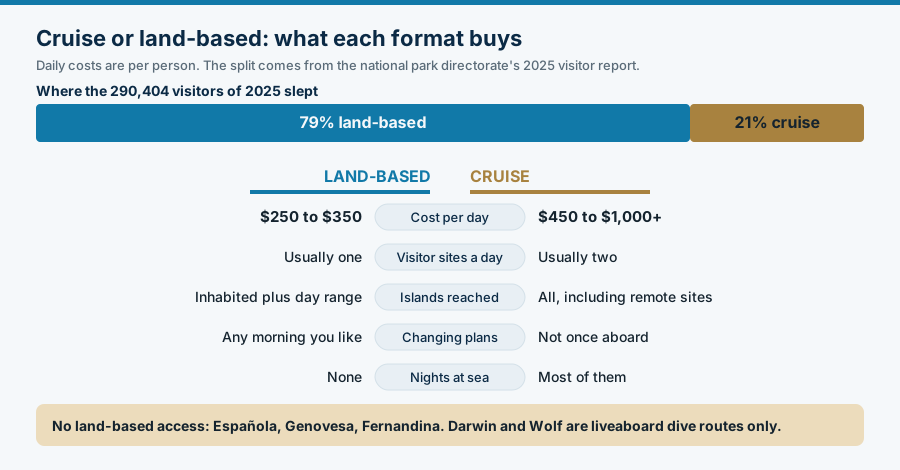
In 2025, 79% of Galapagos visitors stayed land-based and 21% took a cruise. Land-based is cheaper at $250 to $350 per person per day against $450 to $1,000 or more for a cruise, and it gives you flexibility and a bed that does not move. A cruise is the only way to reach Genovesa, Fernandina and Española, and remains the better choice for wildlife completists and anyone short on time.
I should say this first, because it shapes how you read everything below: I run a Galapagos cruise search platform, and my team has catalogued hundreds of cruise itineraries. I have no interest in talking anyone out of a cabin. My own first trip to the islands, in 2021, was land-based island hopping. In 2023 I went back and booked a cruise at the last minute. Both were good trips, and they were not the same trip at all.
Do most Galapagos visitors cruise or stay on land?
Land-based travel now dominates. The park directorate's 2025 report counts 290,404 visitors, of whom 79% stayed on land in the island towns and 21% travelled by cruise. Twenty years ago the balance ran the other way. Hotels, day boats and ferries have quietly become the default Galapagos experience.
That number is worth sitting with, because most published Galapagos advice was written when a cruise was effectively the only serious option. The official visitor statistics for 2025 put total arrivals up 4% on 2024, and the growth is concentrated on the land side. Puerto Ayora, Puerto Baquerizo Moreno and Puerto Villamil have real hotel inventory now, and licensed day boats leave every morning from all three.
None of that makes cruising obsolete. It makes it a specialist choice rather than the default one, and specialist choices are worth making deliberately. What follows is the case for each, made as fairly as I can make it while selling day tours for a living.
What does a Galapagos cruise genuinely do better?
A cruise sails overnight, so it reaches uninhabited islands no day boat can service: Genovesa, Fernandina, Española, and the outer northern sites. It lands at dawn and dusk when animals are active, keeps the same naturalist guide for a week, and removes every logistics decision from your day.
The overnight sailing is the whole mechanism. While you sleep, the ship covers distance that a day boat would have to cross twice inside a single daylight window, burning six hours of fuel and daylight to do it. That is why a cruise can put you on Genovesa's cliff colonies at seven in the morning and a day tour simply cannot.
Guide continuity matters more than people expect. Six days with one naturalist means the explanations build. You get context on day four that would be wasted on day one. Every protected visitor site requires a GNPD-authorised naturalist guide regardless of format, but a cruise gives you the same person for the whole week rather than a different one each morning.
And a cruise removes friction. No ferry timetables, no picking restaurants, no wondering whether the boat you booked is any good. For travellers with two weeks of annual leave and one shot at this, that certainty is worth real money.
| Cruise | Land-based | |
|---|---|---|
| Cost per person per day | $450 to $1,000+ | $250 to $350 mid-range |
| Islands reachable | All, including remote uninhabited sites | Inhabited islands plus day-trip range |
| Visitor sites per day | Usually two, dawn and afternoon | Usually one, mid-morning to mid-afternoon |
| Guiding | Same naturalist all week | New guide each excursion |
| Seasickness exposure | Overnight open-water crossings | Ferry hops and day-boat runs only |
| Flexibility to change plans | None once boarded | Full, book excursions day by day |
| Rest days | Not really possible | Free, and free of charge |
| Money reaching island towns | Limited | Hotels, restaurants, local operators |
What does land-based travel do better?
Land-based costs roughly a third to a half of a comparable cruise, lets you choose each day as it comes, gives you a bed that is not moving at three in the morning, and puts your money into island towns. You also get the free sites: beaches, trails and lava fields that cost nothing at all.
Cost is the headline and the full arithmetic sits in the Galapagos cost breakdown, but flexibility is the argument I find more persuasive after three visits. On a cruise the itinerary is filed with the park and cannot change. On land you wake up, look at the weather, and decide. If the sea is rough you take the highlands and the tortoise reserve instead. If you are tired you walk to Tortuga Bay and swim, which is what I did more than once, and it costs nothing beyond forty minutes on a paved trail.
Seasickness is the quiet dealbreaker. Cruise ships in the Galapagos are small, typically sixteen to a hundred passengers, and the overnight crossings between islands can be rough, especially in the cool garúa season when the wind picks up. Plenty of people spend a $6,000 week medicated and horizontal. Land-based travel confines rough water to a two-hour ferry or a day-boat run you can skip.
The land format also lets you eat where the crews eat, sleep in a $40 room or a $140 one, and spread a week across two islands at your own pace. A day like the Isabela trip to Tintorera Islet and the flamingo wetlands covers snorkelling, white-tipped reef sharks and a lagoon full of flamingos in ten hours, and you can check live availability & prices on Viator without committing to anything else. That is a cruise-grade day bought one day at a time. The rest of the Isabela day tours work the same way.
Which islands can you only reach on a cruise?
Genovesa, Fernandina, Española, Santiago's remoter landings and the northern dive sites at Darwin and Wolf are effectively cruise-only. Santa Cruz, San Cristóbal, Isabela, Floreana, Bartolomé, North Seymour and Santa Fe are all reachable as day trips from an island base.
This is the single most useful table on the page, because it converts an abstract debate into a list of animals you will or will not see.
| Island or site | Reachable land-based? | What it holds |
|---|---|---|
| Santa Cruz | Yes, base island | Tortoise highlands, lava tunnels, Tortuga Bay, Darwin Station |
| San Cristóbal | Yes, base island | Kicker Rock, sea lion colonies, interpretation centre |
| Isabela | Yes, base island | Sierra Negra volcano, Los Túneles, penguins, flamingos |
| Santa Fe | Yes, day tour from Santa Cruz | Endemic land iguana, snorkelling, hidden beach |
| Pinzón | Yes, day tour from Santa Cruz | Snorkelling, rewilded tortoise population |
| Bartolomé | Yes, long day tour from Santa Cruz | Pinnacle Rock, penguins, volcanic landscape |
| North Seymour | Yes, day tour from Santa Cruz | Frigatebirds, blue-footed booby colonies |
| Floreana | Yes, day tour or overnight | Post Office Bay, human mystery, tortoise reintroduction |
| Española | Cruise only | Waved albatross colony, April to December |
| Genovesa | Cruise only | Red-footed boobies, short-eared owls |
| Fernandina | Cruise only | Youngest island, largest marine iguana colonies |
| Darwin and Wolf | Liveaboard dive only | Whale sharks, June to November |
If the waved albatross or the Genovesa seabird cliffs are on your list, a cruise is not a preference, it is a requirement. Those windows also depend on the calendar, which is set out in the seasonal guide.
Who should still book a cruise?
Book a cruise if you want the remote islands, if you have one week and want maximum sites per day, if logistics exhaust you, or if you are a diver aiming at Darwin and Wolf. Stay on land if budget matters, if you get seasick, if you travel with young children, or if you want the freedom to change your mind.
I would rather lose a booking than push someone into the wrong format. The decision usually resolves in under a minute once you are honest about which of these you are.
| You are | Choose | Because |
|---|---|---|
| A wildlife completist chasing albatross and red-footed boobies | Cruise | Española and Genovesa have no land-based access |
| On a fixed budget under about $3,000 for the week | Land-based | Roughly half the daily cost, and you control the spend |
| Prone to seasickness | Land-based | No overnight open-water crossings |
| Travelling with children under ten | Land-based | Town bases, pool time, and the option of a rest day |
| Time-poor with seven days and one visit | Cruise | Two visitor sites a day with no transit overhead |
| A certified diver wanting whale sharks | Liveaboard | Darwin and Wolf are not day-trip accessible |
| Wanting flexibility, towns and local restaurants | Land-based | Book excursions day by day, eat and sleep ashore |
| Travelling with limited mobility | Depends | Some ships handle wet landings poorly; some hotels handle stairs poorly |
Can you do both in one trip?
Yes, and it is the most underrated option. A four or five night cruise covering the remote islands, followed by three or four nights based in Puerto Ayora or Puerto Villamil taking day tours, gives you the outer islands and the towns without paying cruise rates for the whole week.
The combination works because the two formats fail in opposite places. A cruise cannot give you a lazy afternoon or a cheap dinner. A land base cannot give you Fernandina. Splitting the week resolves both, and it usually lands somewhere in the middle on cost.
Practically, book the cruise first, since sailings fill months ahead and cabins dictate the dates. Then build the land days around whichever island your cruise ends on, which is normally Baltra for Santa Cruz or San Cristóbal. The Conservancy's trip planning notes are a useful sanity check on itinerary length, and if you are still weighing where to sleep, the island base comparison covers what each town actually offers.
Is a cruise worth the extra money?
If it takes you to Genovesa, Fernandina or Española, yes, because there is no alternative route to those islands. If it sails only around Santa Cruz, Santa Fe and Bartolomé, you are paying cruise rates for sites that day boats reach from town.
Do land-based visitors see fewer animals?
Fewer species, not fewer animals. Sea lions, marine iguanas, giant tortoises, penguins, sharks and rays are all accessible from the inhabited islands. What you miss are the endemic colonies on the remote uninhabited islands.
How rough are the overnight cruise crossings?
Variable, and worse in the cool season from June to November when the wind strengthens. Ships are small by cruise standards, sixteen to a hundred passengers, so they move. If you know you are susceptible, plan for it or stay on land.
Can I book a cruise once I am already in the islands?
Sometimes. Last-minute cabins do appear and can be discounted, which is exactly how I booked in 2023. It is a gamble rather than a plan: availability in high season is thin and you may spend days waiting for a berth that never opens.