How Many Galapagos Giant Tortoises Are Left?
Roughly 20,000 to 25,000 across the archipelago today, rebuilt from populations that fell to fifteen adults on one island. The recovery numbers, the February 2026 Floreana release, and where you can actually see them.
 By Oleg Galeev, Galapagos travel writer, three trips to the islands
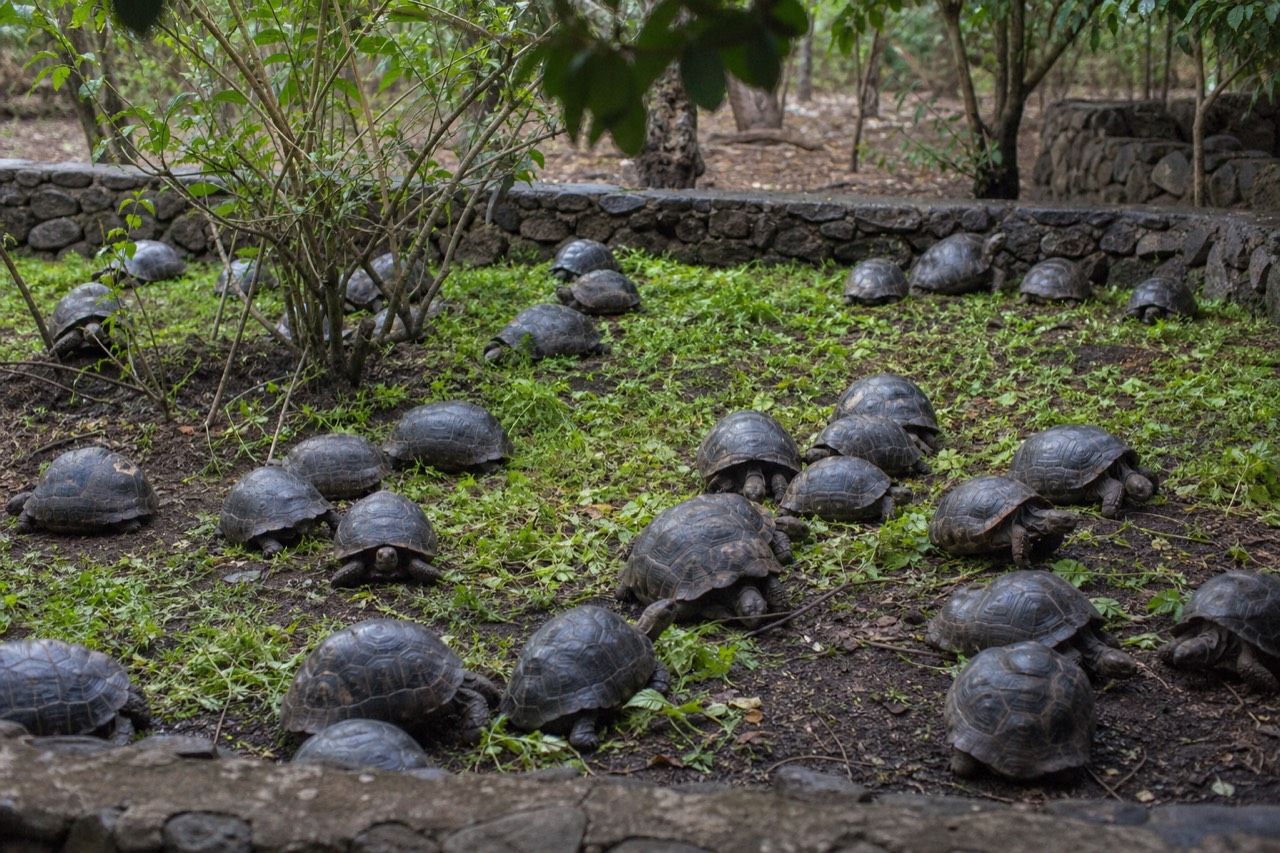
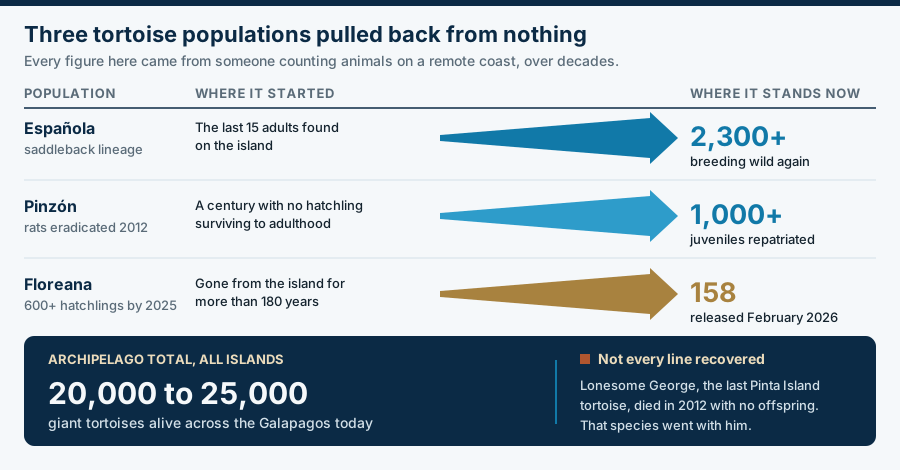
Fifteen. That is how many adult Española tortoises were left when biologists went looking for them, scattered so far apart across the island that they had stopped finding each other to breed. Today that same population is past 2,300 animals living wild. The wider figure for the archipelago is somewhere between 20,000 and 25,000 tortoises across all islands, and every one of those numbers is the result of somebody driving a boat to a remote coast and counting. On my first trip in 2021 I did what almost everyone does and went to the Santa Cruz highlands to see them, which is the easy version of a story that took fifty years of unglamorous work.
How many Galapagos giant tortoises are alive today?
Roughly 20,000 to 25,000 giant tortoises live across the Galapagos archipelago now. That total is spread unevenly across separate island populations, some of which are self-sustaining and some of which still depend on captive breeding and annual repatriation of juveniles. Several named species are already extinct.
The number sounds healthy until you set it against what the islands once held. Buccaneers, sealers and whalers loaded live tortoises into ships' holds for centuries because the animals survived months without food or water, which made them the most convenient fresh meat in the Pacific. Whole island populations went first, and the ones that survived were then hollowed out from below by rats, pigs, dogs and goats that arrived on the same ships.
The last Pinta Island tortoise, Lonesome George, died in 2012 with no offspring, and his species went with him. That is the outcome the breeding programmes exist to prevent everywhere else. The Galapagos Conservation Trust's tortoise page sets out how the named species divide up between the islands, including the saddleback and domed shell shapes that track how much vegetation an island grows.
| Population | Where it started | Where it stands now |
|---|---|---|
| Española | The last 15 adults found on the island | Passed 2,300 animals, breeding naturally in the wild |
| Pinzón | No hatchling survived to adulthood for roughly a century | Over 1,000 juveniles repatriated; black rats eradicated in 2012 |
| Floreana lineage | Functionally gone from the island for over 180 years | 158 juveniles released in February 2026; over 600 hatchlings bred by 2025 |
| All islands combined | Reduced to a small fraction of the original total | Roughly 20,000 to 25,000 |
What actually caused the collapse, and what still threatens them?
Direct harvesting by ships wiped out the bulk of the population over three centuries. Introduced species finished the job more quietly, because rats eat eggs and hatchlings while goats strip the vegetation adults need. Removing those animals, island by island, is what made recovery possible at all.
Pinzón is the clearest illustration. Adult tortoises there survived fine, some of them for over a hundred years, but black rats ate every hatchling that emerged. The population was a museum of old animals with no young. When rats were eradicated from the island in 2012, hatchlings began surviving in the wild for the first time in living memory. That single intervention did more than decades of protection alone.
| Pressure | Period | Status now |
|---|---|---|
| Harvesting by buccaneers, sealers and whalers | 17th to 19th centuries | Ended; the damage is permanent |
| Introduced black rats eating eggs and hatchlings | 19th century onward | Eradicated on Pinzón in 2012; controlled elsewhere |
| Feral goats stripping highland vegetation | 19th century onward | Removed from several major islands |
| Feral pigs, dogs and cats raiding nests | 19th century onward | Controlled, ongoing effort |
| Roads, farming and human settlement | 20th century onward | Ongoing on the inhabited islands |
What was the February 2026 Floreana release?
In February 2026 the park released 158 juvenile tortoises of the Floreana lineage onto Floreana, the first time that bloodline had been on the island in more than 180 years. The animals came from a captive breeding programme that had produced over 600 hatchlings by 2025, built from hybrids carrying Floreana genes.
The Floreana tortoise was written off as extinct. What changed is that genetic work on tortoises living on the slopes of Wolf Volcano, on northern Isabela, found animals carrying substantial Floreana ancestry, almost certainly descended from tortoises dumped overboard by whalers. Breeding from those hybrids over successive generations concentrated the lineage back towards something close to the original.
Releasing them is the harder half. Juveniles are head-started in captivity until their shells are hard enough to survive predators, then moved out in batches and monitored. The rewilding programme publishes progress as it goes, and the Floreana reintroduction is the current flagship. Floreana also has a strange human history that shadows the conservation story, which we cover separately in the Floreana affair.
When do giant tortoises breed, and does that change what you see?
Breeding runs through the hot season, roughly January to May, and eggs hatch after about 130 days in the ground. Females walk down from the highlands to dry lowland nesting areas to lay. Outside that window the adults spend more time in the wet uplands, which is where visitors usually find them.
That seasonal movement is why the highland ranches on Santa Cruz work so well as a viewing site. Wild tortoises move onto farmland to graze in the cooler garúa months, in numbers, without anyone managing them. You are not looking at a collection. You are looking at animals that happen to be crossing a field, and the farms have simply built trails around them.
| Stage | Timing | What happens |
|---|---|---|
| Mating | Hot season, January to May | Males compete by height, the taller neck wins without a fight |
| Nesting | Following the mating period | Females descend to dry lowland ground and dig a nest chamber |
| Incubation | About 130 days | Nest temperature influences the sex of the hatchlings |
| Head-starting in captivity | Several years | Juveniles are raised until hard-shelled enough to survive predators |
| Repatriation | Ongoing, in batches | Animals are released onto their island of origin and monitored |
Where can you actually see giant tortoises?
On Santa Cruz you can see wild tortoises in the highlands year-round and captive juveniles at the breeding centre in Puerto Ayora. Isabela and San Cristóbal each have their own breeding centre. The remote wild populations, including Alcedo on Isabela, are cruise-only and need a park guide.
For most visitors the choice is simple. The Santa Cruz highlands give you wild adults, a short drive from town, on private reserves that also sit on top of collapsed lava tubes you can walk through. That combination is why the half-day highlands run is the one many people fit in even on a tight schedule. If you have one free morning and want tortoises without a boat, the giant tortoise and lava tunnels tour is the version that does both properly, and you can check live availability & prices for your dates. The rest of what runs from Puerto Ayora is on our Santa Cruz day tours page.
One warning worth taking seriously. Tortoises will walk towards you, and the two-metre distance rule still applies in that situation, as the park's visitor rules make clear. Reserve staff will also insist you stay out of the mud wallows, which look empty and often are not.
| Where | Island | Wild or captive | Access |
|---|---|---|---|
| Highland reserves and ranches | Santa Cruz | Wild adults grazing on private land | Taxi or half-day tour from Puerto Ayora |
| Fausto Llerena breeding centre | Santa Cruz | Captive juveniles and adults | Walk from Puerto Ayora |
| Arnaldo Tupiza breeding centre | Isabela | Captive juveniles | Walk or bike from Puerto Villamil |
| Galapaguera de Cerro Colorado | San Cristóbal | Semi-wild, managed | Taxi from Puerto Baquerizo Moreno |
| Alcedo Volcano and remote coasts | Isabela | Fully wild, largest population | Cruise itineraries with a park guide only |
If tortoises are the reason you are coming, it is worth reading our wildlife tours guide before you book anything, because several day boats sold as wildlife trips are really snorkelling trips with a beach stop attached.
How long do Galapagos giant tortoises live?
Well over a hundred years in the wild, and individuals in captivity have been documented past that. Their slow maturity is part of why recovery programmes take decades to show results.Are giant tortoises still endangered?
Yes. Recovery has been real and measurable, but populations remain far below historical levels, several named species are extinct, and some islands still depend on captive breeding and repatriation.Can I touch a tortoise?
No. The minimum distance is two metres at all times, including when the animal moves towards you. Touching wildlife is prohibited across the national park.What happened to Lonesome George?
He was the last known Pinta Island tortoise and died in 2012 without producing offspring. Attempts to breed him with females from related populations were unsuccessful.Do I need a guide to see tortoises on Santa Cruz?
Not at the private highland reserves or the breeding centre in town, which are outside the protected visitor site system. A park-authorised naturalist guide is required at national park visitor sites.Fifteen animals to more than two thousand is not a story about tortoises being resilient. Tortoises are the opposite of resilient, which is exactly the point. The recovery happened because people counted, removed rats, and then waited a very long time.