Galapagos Wildlife Tours: What You'll See and When
Galapagos wildlife runs on a calendar. Boobies court in one window, albatross vanish for three months, tortoises breed in the heat. Here is what is where, and when.
 Written with Oleg Galeev, Galapagos travel writer, three trips to the islands
Short answer
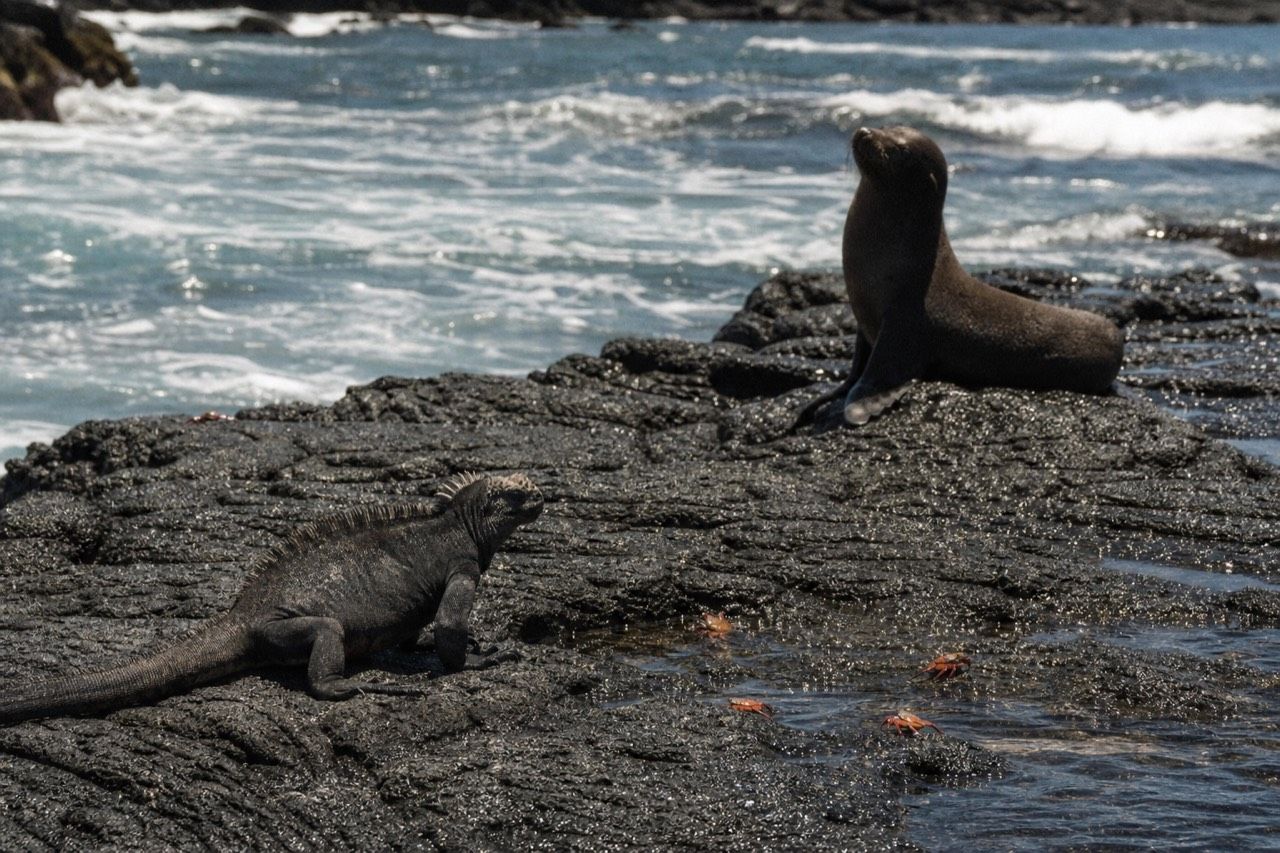
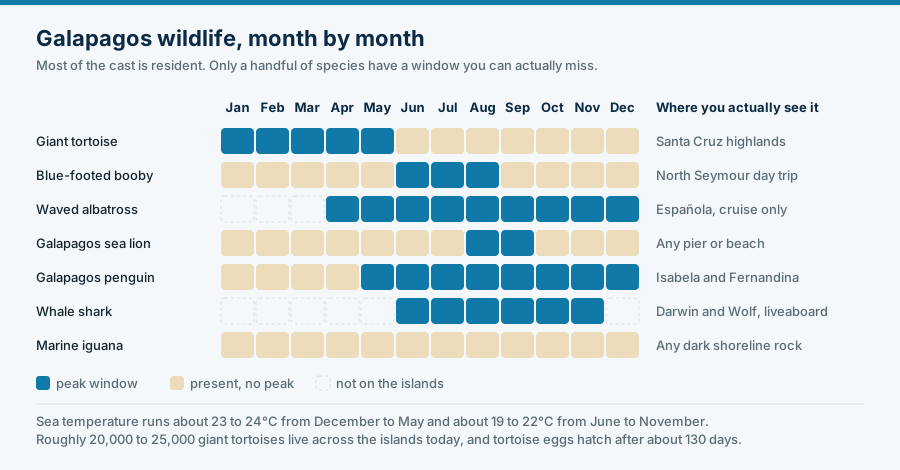
Sea lions, marine iguanas, frigatebirds and finches are near-certain on almost any day tour. Blue-footed boobies court between June and August, waved albatross are on Española from April to December and absent January to March, giant tortoises breed in the hot season from January to May, and sea lion pupping peaks in August and September.
The first marine iguana I ever saw was not on a tour at all. It was on the sandy track out to Tortuga Bay on Santa Cruz, black on black volcanic rock, so still I nearly stepped on it before my brain registered a shape. Then I noticed there were nine more. That is the thing nobody quite prepares you for out here: the animals are not hiding, and they are not running. Most of the work of seeing Galapagos wildlife is being in the right place in the right month, because the calendar does more for you than any amount of patience.
What follows is species by species, with the month and the practical route to each one.
What will you definitely see on a Galapagos day tour?
Sea lions, marine iguanas, frigatebirds, lava lizards and Darwin's finches are close to guaranteed on almost any day out, in any month. Blue-footed boobies are very likely on seabird islands. Giant tortoises need a highlands trip or a breeding centre. Penguins, red-footed boobies and waved albatross all need a specific island.
The baseline is high. Galapagos sea lions colonise the piers, the beaches and occasionally the benches in Puerto Baquerizo Moreno, and they show up on essentially every boat itinerary. Marine iguanas cluster on any dark shoreline rock. Frigatebirds follow the boats. Finches hop around your feet at the lunch stop.
Beyond that baseline, the archipelago is not one habitat. It is a set of islands with different ages, elevations and currents, and species distributions follow that. Red-footed boobies nest on outer islands most day boats do not reach. Penguins concentrate in the cooler western waters around Isabela and Fernandina. The waved albatross nests on exactly one island in the archipelago. So the honest planning question is not "will I see wildlife" but "which island am I standing on, and in which month".
How do you tell the three booby species apart?
By feet and face, not by size. Blue-footed boobies have bright turquoise-blue feet and a mottled brown head. Red-footed boobies have red feet, a blue bill and are the smallest of the three, nesting in trees rather than on the ground. Nazca boobies are the largest, clean white with black wing edges and an orange bill.
Feet first, every time. The blue-footed booby is the one on the postcards, and the colour is genuinely that intense in daylight. Males show it off deliberately in the courtship dance, lifting each foot in turn in front of a female while pointing bill and wings skyward. That display runs from June through August, so a winter trip means a lot of standing around and a summer trip means a show.
Red-footed boobies confuse people because there is a white morph and a brown morph, and the brown one looks nothing like the pictures. Go by the red feet and the pale blue bill. They nest in shrubs and low trees, which is a giveaway on its own, since the other two nest on bare ground.
Nazca boobies are the big clean white ones, and once you see the sharp black trailing edge on the wing and the orange-pink bill, you stop confusing them with anything. They also nest on open ground, often near cliff edges where the takeoff is easy.
| Species | Feet | Face and bill | Nests | Easiest to see |
|---|---|---|---|---|
| Blue-footed booby | Bright turquoise-blue | Mottled brown head, dark bill | Bare ground, in scrapes | Seabird islands, courtship June to August |
| Red-footed booby | Red | Pale blue bill, smallest of the three | In shrubs and trees | Outer islands, rarely on standard day tours |
| Nazca booby | Grey-green, not showy | White body, black wing edges, orange bill, largest | Bare ground, near cliffs | Cliff-edge colonies on outer islands |
Where do you see giant tortoises in the wild?
In the humid highlands of Santa Cruz and on Isabela, plus the breeding centres. Wild adults move up into the uplands and are reliably visible on private reserves reached by road from Puerto Ayora. Breeding runs through the hot season, January to May, and eggs hatch after roughly 130 days.
There are two entirely different experiences here and people mix them up. A breeding centre shows you tortoises of every age in enclosures, with the conservation story attached. A highland reserve shows you wild adults in wet grass and mud, doing nothing at all, very slowly, which is somehow better.
The Galapagos giant tortoise is not one animal but a set of island lineages with different shell shapes, saddle-backed on dry low islands and dome-shaped on wet high ones. Roughly 20,000 to 25,000 survive across the archipelago today, which sounds healthy until you learn Española was down to 15 adults before the captive programme rebuilt it past 2,300. The rest of those numbers sit in the giant tortoise numbers post.
Practically: a highlands morning from Puerto Ayora runs about three hours and usually pairs the reserve with a lava tunnel walk. It is the cheapest wildlife certainty on the islands and it needs no boat. Everything else departing Puerto Ayora is on the Santa Cruz day tours page.
Which month is best for which animal?
Depends entirely on the species. June to August is booby courtship. August and September are peak sea lion pupping. April to December is the waved albatross window on Española. January to May is tortoise breeding and warm water. There is no bad month, only months that suit different animals.
Sea temperature drives most of it. The warm season from December to May sits around 23 to 24°C with calmer water, and the cool garúa season from June to November drops to about 19 to 22°C with more nutrients, more plankton and busier feeding. That is why the seabirds breed when the water is cold and the reptiles breed when the land is hot.
| Month | What is happening |
|---|---|
| January | Tortoise breeding season opens; waved albatross absent; sea 23 to 24°C |
| February | Tortoise breeding; albatross still absent; warm calm water |
| March | Tortoise breeding; last month with no albatross on Española |
| April | Tortoise breeding; waved albatross return to Española; warm water |
| May | Final month of tortoise breeding; penguin nesting window opens |
| June | Blue-footed booby courtship begins; whale sharks arrive at Darwin and Wolf; water cools to 19 to 22°C |
| July | Booby courtship in full swing; cool nutrient-rich water; whale shark season |
| August | Booby courtship ends; sea lion pupping peaks; whale sharks present |
| September | Sea lion pupping peak continues; coolest, roughest water of the year |
| October | Penguin nesting; albatross on Española; whale sharks still at the northern sites |
| November | Last month of the whale shark window; albatross present; water starts warming |
| December | Albatross begin leaving; warm season returns at 23 to 24°C; penguin nesting closes |
Which day tour actually gets you to the seabird colonies?
North Seymour, from Santa Cruz. It is the one small island close enough to Baltra for a day boat that holds substantial blue-footed booby and frigatebird colonies plus land iguanas. Expect a full day, roughly nine hours door to door, with the trail circuit and a snorkel or beach stop.
North Seymour sits just north of Baltra, so the crossing is short compared to the outer islands, and the trail is a flat loop through nesting ground rather than a climb. Frigatebird males inflate scarlet throat pouches there in the breeding period, and boobies nest directly beside the path, which is where the two-metre rule gets genuinely difficult to obey because the birds do not respect it.
If seabirds are the reason you came, this is the day to book, and you can check live availability & prices on the operator's listing before you commit to dates. The listing shows a nine-hour day departing from Santa Cruz. Review volume on these platforms is thin across the board, so read the itinerary rather than the star count, and compare the alternatives on the Santa Cruz day tours page.
Where do the marine iguanas, sea lions and penguins actually turn up?
Marine iguanas are everywhere there is dark shoreline rock, including town beaches. Sea lions colonise piers and beaches on all inhabited islands and pup mainly in August and September. Galapagos penguins concentrate in the cooler western waters around Isabela and Fernandina, breed year-round and may nest any time from May to December.
Marine iguanas are the least effort of any Galapagos animal to see and the most interesting to watch, because they feed by grazing algae underwater and then haul out to reheat. Cold iguanas are sluggish. Warm iguanas sneeze salt, which is a real thing they do and it will land on you.
Sea lions are the ones you meet in the water. Juveniles will come and spiral around a snorkeller out of pure curiosity, and that encounter, more than any bird, is what people describe on the boat afterwards. The snorkelling with sea lions post covers the etiquette, which mainly means not chasing them and letting the animal set the distance.
The Galapagos penguin is the hardest of the three. It is the only penguin found north of the equator and it needs the cold upwelling on the western side, so an Isabela base gives you a real chance and a Santa Cruz base gives you a slim one. The Isabela day tours that run to Tintoreras and Los Túneles pass the rocky shorelines where they perch.
| Species | Where you actually see it | Best months | Realistic route |
|---|---|---|---|
| Giant tortoise | Santa Cruz highlands, Isabela, breeding centres | Year-round, breeding January to May | Road-based highlands tour from Puerto Ayora |
| Blue-footed booby | Seabird islands and cliff coasts | Courtship June to August | North Seymour day trip from Santa Cruz |
| Marine iguana | Any dark shoreline rock, including town beaches | Year-round | Free, on foot, or any boat tour |
| Sea lion | Piers, beaches, snorkel sites, all inhabited islands | Pupping peaks August and September | Any bay or island day tour |
| Galapagos penguin | Western waters, Isabela and Fernandina | Nesting possible May to December | Tintoreras or Los Túneles from Puerto Villamil |
| Darwin's finches | Highlands and lunch stops, all islands | Year-round | Any highlands trip |
| Waved albatross | Española only | April to December, absent January to March | Cruise itinerary, not a standard day tour |
Are Darwin's finches worth looking for?
Yes, but manage the expectation. They are small, brown, unassuming birds that look almost identical to each other, and the interest is entirely in the beaks. Different species evolved different bill shapes for different food, which is the observation that fed into Darwin's thinking. They are common in the highlands and around lunch stops.
Nobody photographs a finch and puts it on a fridge. What makes them worth two minutes of your guide's time is that they are the clearest living demonstration of the mechanism the islands are famous for, and a good naturalist guide will show you a heavy seed-cracking bill and a fine probing one within the same clearing.
They are also fearless to the point of comedy. Leave a sandwich unattended at a highland reserve and you will get a practical lesson in adaptive feeding behaviour.
Where is the waved albatross, and can a day tour reach it?
On Española, and no. Practically the entire world population of waved albatross nests on that one island, arriving around April and leaving by December or January. From January to March they are at sea and the island has none. Española sits on cruise itineraries, not on the day-boat routes from the port towns.
This is the species where honest planning matters most, because it is genuinely spectacular and genuinely hard to reach. The birds have a wingspan over two metres, they perform a long clattering courtship dance, and they launch off a cliff edge because they cannot get airborne easily from flat ground. The waved albatross profile covers the biology.
The travel reality is simpler. Our listed day tours run from Santa Cruz, San Cristóbal and Isabela, and none reach Española. If the albatross is your priority species, that points at a cruise itinerary between April and December, which changes the shape and cost of the whole trip. The best time to visit guide lines the seasons up against price if you are weighing months against budget.
| Wildlife day tour we list | Departs from | Duration | Rating and reviews |
|---|---|---|---|
| Pinzón Island day tour with snorkelling | Santa Cruz | About 7 hours | 4.9 from 154 reviews |
| Santa Fe Island and Hidden Beach | Santa Cruz | About 7 hours | 4.9 from 91 reviews |
| Isabela day trip: Tintoreras, wetlands, flamingos | Santa Cruz | About 10 hours | 4.7 from 138 reviews |
| Giant tortoises and lava tunnels | Santa Cruz highlands | About 3 hours | 4.8 from 80 reviews |
| Bartolomé Island full day | Santa Cruz | About 10 hours | 4.8 from 21 reviews |
| North Seymour day trip | Santa Cruz | About 9 hours | 5.0 from 3 reviews |
Review counts on these platforms are small, because most Galapagos travel is still booked directly with operators rather than through booking sites. A five-star average from three reviews tells you far less than a 4.7 from 138, and neither tells you as much as the itinerary itself.
Common questions
What is the single best month for Galapagos wildlife?
There is no single answer, which is why the calendar matters. June to August gives you blue-footed booby courtship and cool productive water. August and September add peak sea lion pupping. January to May gives warmer, calmer water for snorkelling and active tortoise breeding, but no waved albatross at all.
How close can you get to the animals?
Two metres, six feet, is the national park minimum and it applies even when the animal walks toward you. The animals do not know the rule and will close the gap themselves. Your job is to hold still or step back, not to reposition for a better photograph.
Can I see penguins on a day tour from Santa Cruz?
Possible but unreliable. Galapagos penguins concentrate in the cooler western waters around Isabela and Fernandina, so basing on Isabela and taking a Tintoreras or Los Túneles trip gives you a far better chance than any Santa Cruz departure.
Do I need a telephoto lens?
Less than you would anywhere else on earth. Most encounters happen within a few metres, so a mid-range zoom and a wide lens cover almost everything. Bring a dry bag instead, because the panga landings are wet more often than the itinerary suggests.
Are the animals really unafraid of people?
Yes. The islands had no land predators for most of their history, so the animals never evolved a flight response to large mammals. This is exactly why the two-metre rule exists: the wildlife will not protect itself from you, so the rules have to.