Should You Fly to the Galapagos via Quito or Guayaquil?
Quito flights usually stop in Guayaquil anyway, which makes this a question about altitude, airport transfers and what you want from a stopover rather than about the flight itself.
 By Oleg Galeev, Galapagos travel writer, three trips to the islands
The thing nobody tells you when you book a Quito departure is that your plane is probably going to land in Guayaquil on the way, sit on the tarmac for a while, and then continue. I have flown this routing from both cities and the second leg is identical either way. What differs is everything that happens before you board: how high you slept the night before, how far the airport is from your bed, and whether the city you passed through was worth a day of your trip. Those three things are the whole decision.
Is the flight from Quito actually longer?
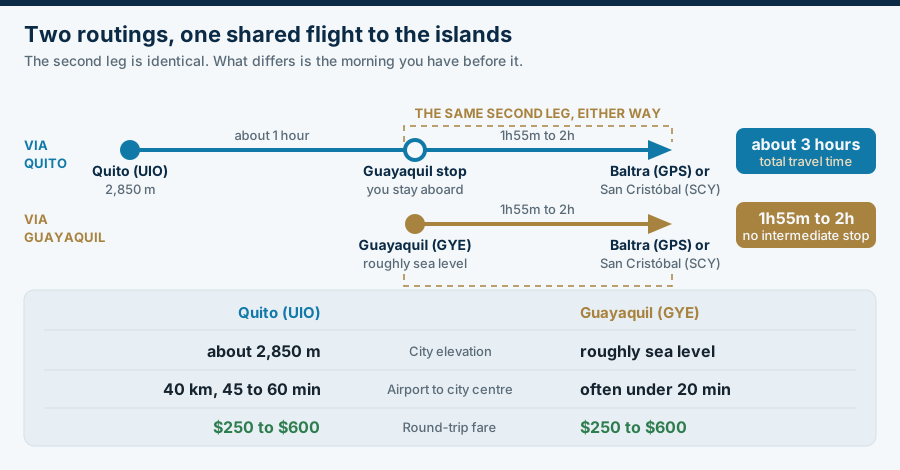
Yes, by about an hour of total travel. Guayaquil to Baltra or San Cristóbal is a direct hop of roughly one hour fifty-five minutes to two hours. From Quito the same journey runs about three hours in total, because most schedules route down to Guayaquil first and pick up passengers before continuing west.
You stay on the aircraft during the stop in most cases. It is not a connection with a bag transfer, just a pause. The practical cost is the extra hour plus an earlier alarm, since Galapagos flights leave in the morning and Quito's airport sits well outside the city.
Avianca and LATAM operate the routes, from Quito (UIO) and Guayaquil (GYE) into Baltra (GPS) for Santa Cruz and San Cristóbal (SCY) for the eastern island. Round-trip fares commonly land somewhere between $250 and $600 depending on season and how far ahead you book. That range does not shift much by departure city, which is another reason the choice comes down to logistics rather than money.
| Factor | Quito (UIO) | Guayaquil (GYE) |
|---|---|---|
| Flying time to the islands | About 3 hours total | About 1h55m to 2h |
| Intermediate stop | Usually stops in Guayaquil | None |
| City elevation | About 2,850 m | Roughly sea level |
| Airport elevation | About 2,400 m at Tababela | A few metres |
| Airport to city centre | 40 km, allow 45 to 60 minutes | Short hop, often under 20 minutes |
| Round-trip fare range | $250 to $600 | $250 to $600 |
| Arrival airports served | Baltra and San Cristóbal | Baltra and San Cristóbal |
Does Quito's altitude matter before a Galapagos trip?
It can. Quito sits at about 2,850 metres, high enough that a meaningful share of visitors get headaches, poor sleep and breathlessness on the first night. Guayaquil is at sea level and asks nothing of you. The islands are at sea level too, so altitude affects only the days before you fly.
The awkward part is direction of travel. Arriving into Quito from Europe or North America usually means a red-eye, then a jump straight to nearly 2,900 metres, then a dawn departure the following morning. Some people are entirely fine. Others spend the night awake with a dull headache and start a once-in-a-lifetime trip already flattened.
If you want Quito, the fix is to give it two nights instead of one and treat the first as a write-off. Drink more water than feels reasonable, skip alcohol on the arrival night, and do nothing strenuous. Coming down from Quito to sea level in the islands is not a problem in itself. Going the other way is where people struggle, which is why a Quito stopover works better at the end of a trip than the start.
| Consideration | Quito | Guayaquil |
|---|---|---|
| Altitude adjustment needed | One to two nights recommended | None |
| Typical first-night effects | Headache, disturbed sleep, breathlessness | None related to altitude |
| Climate | Cool, thin air, big day-to-night swing | Hot and humid year-round |
| Best placed in the itinerary | After the islands, if you want the highlands | Either end, as a pure transit night |
| Onward mainland options | Otavalo, Cotopaxi, Mindo cloud forest | Coast, Cuenca by air, Machalilla |
What has to happen before you board, in either city?
Two things you cannot skip. Your bags go through a mandatory biosecurity inspection at UIO or GYE before check-in, and you need the Transit Control Card, which costs $20 and is registered and paid online before you travel. The $200 park entrance fee is paid separately on arrival in the islands.
The biosecurity check is a real inspection, not a formality. Fresh fruit, vegetables, seeds, plants and many animal products are restricted or banned outright, and the agency publishes the current list of prohibited items so you can clear your bag before you leave home. People lose food they forgot about in a daypack every single morning.
The Transit Control Card is pre-registered online now rather than bought at a counter, which catches out travellers working from older advice. The park entrance fee is the other one: $200 for foreign adults over 12 and $100 for children under 12, paid to park rangers at Baltra or San Cristóbal on arrival. Both are set out on the official park fee page, and we break the fee down properly in where your $200 park fee goes.
| Step | Where it happens | Cost | Timing |
|---|---|---|---|
| Transit Control Card registration | Online, before travel | $20 per person | Days to weeks ahead |
| Baggage biosecurity inspection | UIO or GYE, before check-in | Included | Arrive early, allow extra time |
| Check-in and boarding | UIO or GYE | Fare only | Morning departures |
| Park entrance fee | Baltra or San Cristóbal on arrival | $200 adult, $100 child under 12 | On landing, before you exit |
| Onward transfer to town | Baltra bus and ferry, or SCY taxi | Small local fares | 45 to 90 minutes from Baltra |
Which city is worth a stopover?
Quito, if you want anything from the mainland. Its old town is one of the best preserved in the Americas and the mountains around it are reachable in a day. Guayaquil is a working port city that suits a transit night, an early flight and little else for most visitors.
That is not a slight on Guayaquil. It is simply a different proposition: a river city with a long waterfront walk, good food and a hill of painted houses behind it, but not a place most people would fly to for its own sake. Its advantage is that the airport is close to everything, which on a 6am departure is worth more than a cathedral.
Quito rewards more time. The historic centre is compact and walkable, the surrounding volcanoes are close, and the cloud forest at Mindo drops back down to a comfortable altitude in a couple of hours. If your trip has any mainland ambition at all, that is where it goes. On safety, the US State Department rates Ecuador Level 2, Exercise Increased Caution, and publishes province-level detail that changes over time, so read the current advisory rather than an old blog post before you book a hotel in either city.
| City | Worth it for | Suggested stay | Watch out for |
|---|---|---|---|
| Quito | Colonial old town, volcanoes, Otavalo market, Mindo | Two nights minimum | Altitude on the first night, long airport transfer |
| Guayaquil | Malecón waterfront, Las Peñas, easy airport access | One night as transit | Heat and humidity, limited sightseeing |
| Neither | Straight through to the islands | Same-day connection if timings allow | Tight margins if your international flight is late |
So which should you choose?
Fly via Guayaquil if you want the shortest, simplest route and no altitude to deal with. Fly via Quito if the mainland is part of your trip, and put it after the islands rather than before. If your international arrival lands late at night, Guayaquil is the lower-stress option regardless.
The travellers who regret their choice are almost always the ones who arrived in Quito at midnight and flew out at seven the next morning. You gain nothing and you start the trip tired at altitude. If Quito interests you, give it real days. If it does not, Guayaquil does the job with less friction.
Once you land, the decision that actually shapes your trip is what you do with your days on the islands, not which city you passed through. Most people base on Santa Cruz and take day boats out. A full-day run to Santa Fe Island is one of the better first outings, because the bay is sheltered enough that nervous snorkellers relax and the sea lion colony is right there, and you can check live availability & prices before you fly. Everything else leaving Puerto Ayora is on our Santa Cruz day tours page. If your dates are still loose, itinerary planning and entry rules and flights cover the sequencing in more detail, and the Conservancy's planning pages are a useful sanity check on anything an agency tells you.
Do Quito flights always stop in Guayaquil?
Not always, but most scheduled services do. Check the routing on your specific flight number, because a non-stop from Quito saves close to an hour.Can I connect from an international flight to the islands the same day?
Sometimes, if your international flight lands early and the domestic departure is late enough. It is risky. Galapagos flights leave in the morning, and a delay means losing a paid island day.Which island airport should I fly into?
Baltra if you are basing on Santa Cruz, which most land-based visitors do. San Cristóbal if you are staying in Puerto Baquerizo Moreno. Some travellers fly into one and out of the other.Will I get altitude sickness in Quito?
Many visitors feel something at 2,850 metres, most commonly a headache and broken sleep on the first night. It usually settles within a day or two. Serious altitude illness is uncommon at that height but not impossible.Is the biosecurity check the same at both airports?
Yes. Both UIO and GYE run the mandatory inspection before check-in for Galapagos flights, and the prohibited item list is identical.Book the routing that leaves you rested on the morning you fly west. That is the entire trick, and it is worth more than the hour of flying time either way.