Galapagos Entry Rules, Fees and Flights Explained
Two payments, one inspection and a flight that leaves early. The Galapagos entry process is simple once you know the order it happens in.
 Written with Oleg Galeev, Galapagos travel writer, three trips to the islands
Short answer
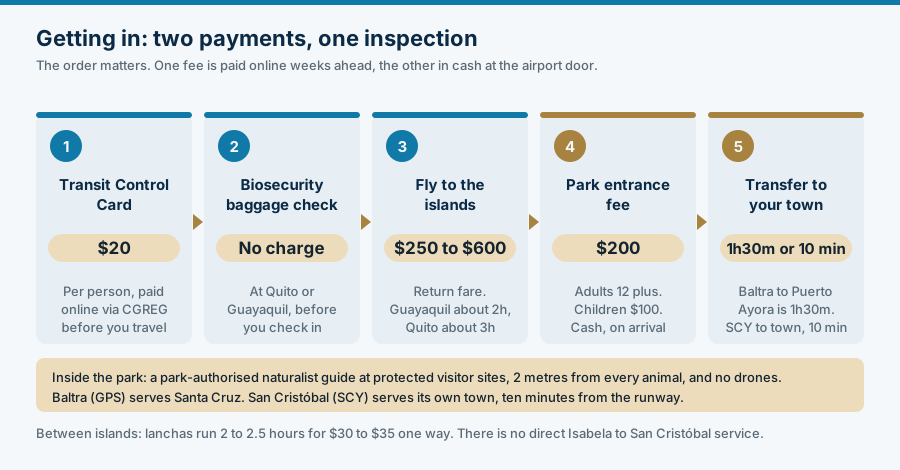
Every foreign adult pays a US$200 Galapagos National Park entrance fee on arrival, US$100 for children under 12, plus a US$20 Transit Control Card registered and paid online before travel. Avianca and LATAM fly from Quito and Guayaquil to Baltra (GPS) or San Cristóbal (SCY), and all luggage goes through a biosecurity inspection before check-in.
On my most recent trip the park fee cost $200. On my first, in 2021, the same desk took half that. The increase landed on 1 August 2024 and it is the single biggest change to Galapagos trip budgets in years, yet plenty of older blog posts still quote the old number and send people to the counter with the wrong cash in hand.
Entry to the islands is genuinely straightforward. It is also sequential, and the sequence catches people out more than the rules do. Here is the order it actually happens in, and the two payments nobody can skip.
What does it cost to enter the Galapagos?
Two mandatory payments. The Galapagos National Park entrance fee is US$200 for foreign visitors over 12 and US$100 for children under 12, paid to park rangers on arrival at Baltra or San Cristóbal. Before that, every traveller registers and pays a US$20 Transit Control Card online through the CGREG system.
The park fee is the one that stings, and it is worth understanding what it buys. It funds the park directorate, the marine reserve patrols and the conservation programmes that keep the archipelago functioning as a wild place rather than a zoo. The official schedule sits on the national park's own fee page, which is the only source worth trusting when a tour operator quotes you something different.
| Payment | Amount | When | Where |
|---|---|---|---|
| Park entrance, foreign adult (12+) | US$200 | On arrival | Park ranger desk, Baltra or San Cristóbal airport |
| Park entrance, foreign child (under 12) | US$100 | On arrival | Same desk |
| Transit Control Card (TCT/INGALA) | US$20 per person | Before you fly | Registered and paid online via the CGREG system |
| Flight, mainland return | About $250 to $600 | At booking | Avianca or LATAM |
The Transit Control Card changed in recent years. It used to be a paper card bought in a queue at the mainland airport. Now you pre-register online and pay before travel, which removes one queue but adds one task to do at home. Do it before you leave, because sorting it out in a departures hall at five in the morning is nobody's idea of a good start.
Bring cash for the park fee. Card acceptance at the arrival desks has improved but is not something to gamble a $200 payment on, and there is no ATM standing between you and the exit.
Do I need a visa for Ecuador?
Citizens of the United States, the United Kingdom, Canada, Australia and most of the EU do not need a visa for tourist stays in Ecuador of up to 90 days in a 12-month period. You need a passport valid for at least six months. The Galapagos are part of Ecuador, so no separate entry document applies beyond the transit card.
The 90-day allowance is per rolling year, not per entry, which matters if you are combining the Galapagos with a longer South American loop and plan to re-enter Ecuador. Overstaying carries fines.
On safety, the US State Department rates Ecuador at Level 2, Exercise Increased Caution, with higher-level warnings attached to specific mainland provinces rather than to the Galapagos. The islands themselves are among the calmest places in the country, with a small resident population and an economy built entirely on visitors.
Which airport should I fly into, GPS or SCY?
Baltra (GPS) serves Santa Cruz and is the busier hub, with more flights and more day-tour choice, but it needs a bus, a channel ferry and a road transfer before you reach Puerto Ayora. San Cristóbal (SCY) drops you a ten-minute drive from Puerto Baquerizo Moreno, with fewer flights and a quieter base.
This is the first real decision of the trip and it shapes everything after it.
| Baltra (GPS) | San Cristóbal (SCY) | |
|---|---|---|
| Island served | Santa Cruz | San Cristóbal |
| Flight frequency | Highest, both airlines | Fewer daily services |
| Transfer to town | Bus, Itabaca Channel ferry, then road to Puerto Ayora, most of a morning | Short taxi ride into town |
| Day-tour choice | Widest in the archipelago | Good, more focused on Kicker Rock |
| Ferry connections | Direct lanchas to Isabela and San Cristóbal | Direct lancha to Santa Cruz only |
| Best for | First visit, island hopping, most itineraries | Slower trips, sea lions, diving |
Most people fly into Baltra and out of San Cristóbal, or the reverse. The airlines price open-jaw Galapagos routings much the same as returns, and it saves you a backtracking ferry day. If you want the arithmetic on how those days add up, how many days you need works through it properly.
The Baltra transfer deserves a warning. You clear the fee desk, collect bags, take a shuttle bus to the Itabaca Channel, cross on a small vehicle ferry, then take a bus or taxi south across the island to Puerto Ayora. It is not difficult and it is well signposted, but it eats a chunk of the day. Anyone landing at midday should assume they reach their hotel mid-afternoon.
Who flies there, and how much does it cost?
Avianca and LATAM operate the Galapagos routes from Quito (UIO) and Guayaquil (GYE). Guayaquil to the islands takes about 1h55m to 2 hours. From Quito it runs roughly 3 hours in total, because almost every Quito service stops in Guayaquil. Round-trip fares commonly land between $250 and $600.
Every flight from Quito touches down in Guayaquil. You usually stay on board, passengers get on and off, and the aircraft continues. That stop is why the Quito routing takes half as long again for the same distance covered.
| Route | Typical block time | Notes |
|---|---|---|
| Guayaquil (GYE) to Baltra (GPS) | About 1h55m to 2h | The shortest, most direct option |
| Quito (UIO) to Baltra (GPS) | About 3h total | Includes the Guayaquil stop |
| Guayaquil (GYE) to San Cristóbal (SCY) | About 2h | Fewer services per day |
| Quito (UIO) to San Cristóbal (SCY) | About 3h total | Also via Guayaquil |
There is a real argument for overnighting in Guayaquil before an early island flight rather than doing a pre-dawn start from Quito at 2,850 metres of altitude. Which mainland city makes the better staging post is its own question, and Quito versus Guayaquil compares them on the things that matter for a Galapagos connection.
Fares move with season. The June to August and December to January peaks push toward the top of that range, and residents pay a different, much lower fare structure that foreign visitors cannot access.
What happens at the biosecurity inspection?
Before you check in at Quito or Guayaquil, all luggage passes a mandatory SICGAL and Agrocalidad inspection. Bags are scanned, occasionally opened, and any fresh fruit, vegetables, seeds, plants, soil or restricted animal products are removed. Allow twenty extra minutes and arrive earlier than you would for a normal domestic flight.
The inspection sits at a separate counter before the airline desks, and the queue for it is not part of your check-in queue. This is the most common reason people who allowed ninety minutes end up sprinting.
The restricted list is published by the Galapagos biosecurity agency, and the full product list is worth a glance the night before you pack. Most of it is common sense once you understand the logic: introduced species are the archipelago's biggest threat, and a seed, an insect egg or a scrap of soil in a boot tread is how new ones arrive. Our packing guide goes through the confiscation list item by item.
There is a second, lighter check on arrival in the islands, and again when you move between islands by ferry on some routes. Nobody makes a fuss if your bag is clean.
How do you get between the islands?
Public speedboats called lanchas run daily between Santa Cruz and Isabela, and between Santa Cruz and San Cristóbal. Each crossing costs about $30 to $35 one way and takes two to two and a half hours. There is no direct Isabela to San Cristóbal service: you transfer through Santa Cruz, which costs a full day.
Santa Cruz is the hub, and that geography dictates most land-based itineraries. Boats typically leave in the early morning and again in the afternoon, so a transfer day is really a half day plus a wasted afternoon.
| Route | Time | Cost one way | Notes |
|---|---|---|---|
| Santa Cruz to Isabela | About 2 to 2.5 hours | $30 to $35 | Open ocean, often rough |
| Santa Cruz to San Cristóbal | About 2 to 2.5 hours | $30 to $35 | Similar conditions |
| Isabela to San Cristóbal | A full day | $60 to $70 | No direct boat, transfer via Santa Cruz |
| Inter-island flights (Emetebe) | Around 30 minutes | Considerably more | Small aircraft, tight baggage limits |
The lanchas are small, fast and exposed. Swell in the channels is real, seats near the back move less, and motion-sickness tablets taken an hour before departure make the difference between an unpleasant morning and a fine one.
What should you do on your first day?
Book something short and near the airport road rather than a full-day boat. Flights land late morning at the earliest, transfers eat the afternoon, and a ten-hour ocean tour on arrival day is a bad trade. The Santa Cruz highlands work because they sit on the route from Baltra to Puerto Ayora.
Wild giant tortoises graze the highland farms year-round, and the collapsed lava tunnels nearby take twenty minutes to walk. A short trip like the Giant Tortoise and Lava Tunnels tour runs about three hours from Puerto Ayora, which fits an arrival afternoon without any risk of missing it if your flight slips. You can see what the operator includes and check live availability & prices on Viator. The rest of the island's options sit on the Santa Cruz day tours page.
Save the long boat days for when you have a full morning and no luggage to think about.