The Free Walk to Tortuga Bay That Beats Some Paid Tours
A 2.5 km paved trail from Puerto Ayora, no guide, no ticket, marine iguanas on the sand and a calm lagoon at the far end. How to do Tortuga Bay properly and when to go instead of paying for a boat.
 By Oleg Galeev, Galapagos travel writer, three trips to the islands
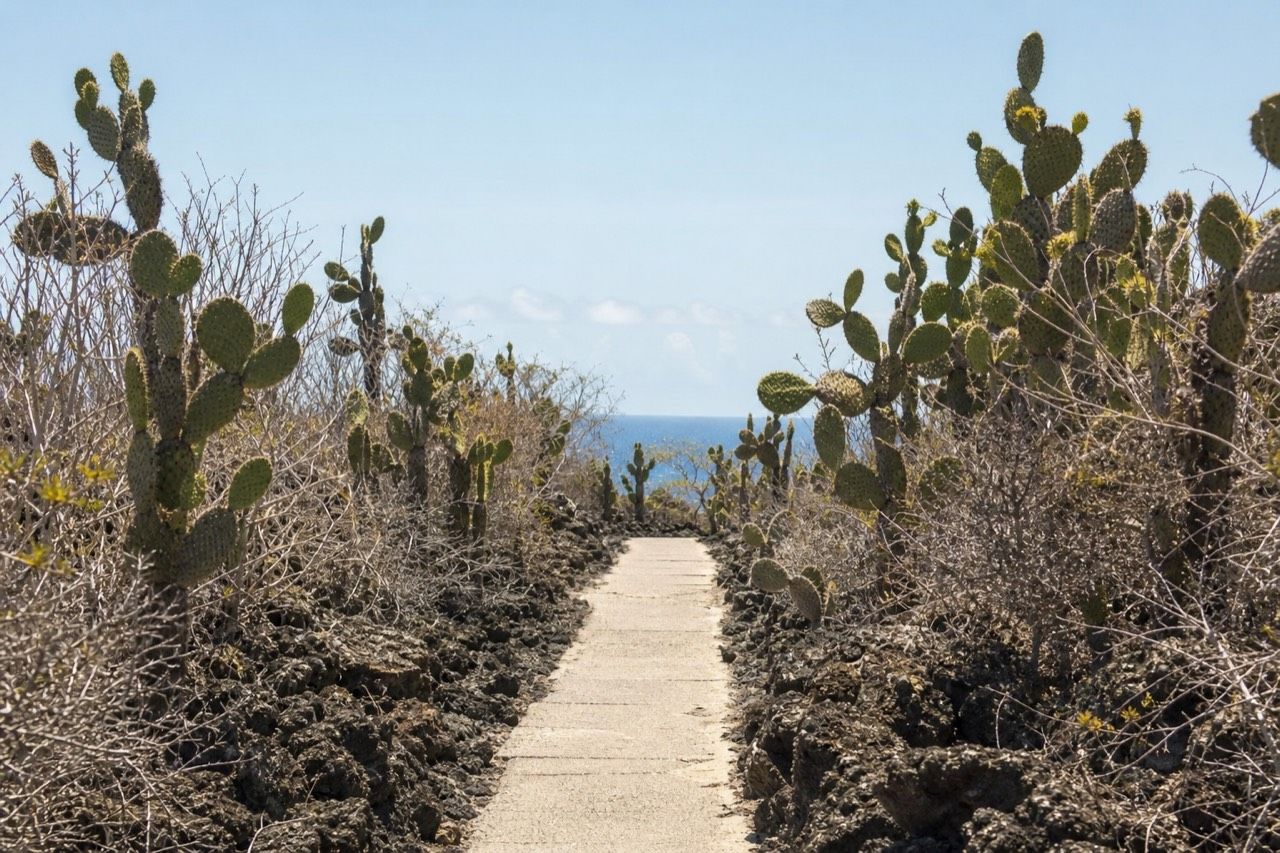
The first marine iguana I saw at Tortuga Bay was lying in the middle of the sand like something dropped there, black on white, so still that I walked past it before my brain registered it as an animal. Nobody had taken my money. Nobody had briefed me. I had walked out of Puerto Ayora past a hut where a park officer wrote my name in a book, followed a concrete path for forty minutes through cactus scrub, and arrived at a beach that most paid excursions in the Caribbean would charge a hundred dollars to show you. Santa Cruz gives that one away, and I think saying so out loud is more useful than pretending every good thing in the Galapagos needs a ticket.
How do you get to Tortuga Bay, and do you need a guide?
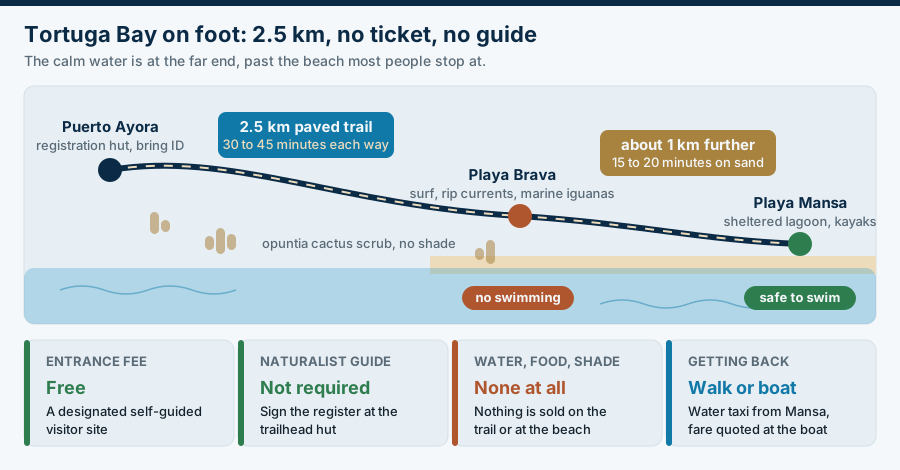
You walk. The trail starts at the western end of Puerto Ayora, at the top of Charles Binford street, and runs about 2.5 km on a paved path to the beach. Tortuga Bay is a self-guided visitor site, so no naturalist guide is required, no tour is needed and there is no entrance fee.
At the trailhead there is a small hut where a park officer registers you. Bring ID, sign in, and remember to sign out on the way back, because the register is how they know whether anyone is still down there at closing. The gate opens early in the morning and closes in the late afternoon, and the posted hours at the hut are the ones that count.
The path itself is concrete block, wide, and rises gently before dropping towards the coast. It takes most people thirty to forty-five minutes each way. There is no shade of consequence and nothing is sold anywhere along it or at the beach, which is the single most common mistake visitors make. Carry more water than you think you need. The scrub either side is opuntia cactus and palo santo, and if you walk slowly you will pick up Darwin's finches, mockingbirds and lava lizards without trying.
| Stage | Distance | Rough time | What is there |
|---|---|---|---|
| Registration hut, Charles Binford street | 0 km | A few minutes | Sign the register, show ID, check posted hours |
| Paved trail through cactus scrub | 2.5 km | 30 to 45 minutes | No shade, no water, finches and lava lizards |
| Playa Brava | At the end of the trail | Arrive | Long surf beach, strong rip currents, marine iguanas |
| Spit and mangrove path to Playa Mansa | About 1 km further | 15 to 20 minutes | Calm lagoon, kayak rental, mangroves |
| Return on foot, or water taxi from Mansa | 2.5 km back | 30 to 45 minutes | Fare quoted at the boat, no fixed published price |
What is the difference between Playa Brava and Playa Mansa?
Playa Brava is the long surf beach you reach first. The name means rough, and it earns it: strong rip currents, real waves, and no swimming. Playa Mansa is the sheltered lagoon at the far western end behind a sand spit, calm enough for a float and where the kayaks are.
Most people arrive at Brava, take one look at the water, and stop there. That is a mistake worth avoiding. Keep walking along the sand to the end, cut through the short mangrove path, and Mansa opens up: turquoise, flat, shallow, backed by mangrove. White-tip reef sharks come into the shallows, rays cross the sand bottom, and pelicans work the edge of the mangrove.
The marine iguanas are on both beaches but they cluster at the Brava end, hauled out on the sand and rocks in numbers that look staged. The park's two-metre distance rule applies to every one of them, including the ones lying directly across the path you wanted to take, and the official visitor rules are explicit that it is your job to move rather than theirs. Nobody is standing there enforcing it. That is precisely why it matters.
| Feature | Playa Brava | Playa Mansa |
|---|---|---|
| Position | End of the paved trail | About 1 km further west, behind the spit |
| Water | Heavy surf, strong rip currents | Sheltered, shallow, calm |
| Swimming | Not safe, not permitted | Yes, the reason people walk on |
| Wildlife you tend to see | Marine iguanas, Sally Lightfoot crabs, pelicans | Reef sharks, rays, herons, mangrove birds |
| Activities | Walking, surfing at the eastern end | Kayaking, snorkelling in shallow water |
When should you go, and what should you take?
Early morning is the best combination of cool air, soft light and empty sand. Late afternoon is the second-best window. The middle of the day is the one to avoid, because the trail has almost no shade and there is nowhere at the beach to buy water or shelter.
Time your return against the posted closing time rather than against how you feel. The walk back is uphill for the first stretch and slower than the walk out, especially if you have spent three hours in the sun. Rangers do come down to clear the beach, and being the group they have to chase is a poor way to end a good morning.
| Time window | Conditions | How busy | What you see |
|---|---|---|---|
| Early morning | Coolest, soft low light | Quietest of the day | Iguanas still cold and motionless, birds most active |
| Mid morning | Warming quickly | Steady flow of walkers | Iguanas moving onto the sand to bask |
| Midday to mid afternoon | Hottest, harsh overhead light, zero shade | Moderate | Full basking, poor photographs |
| Late afternoon | Cooling, warm light | Second peak | Surfers at the eastern end, good light on the lagoon |
| Take | Why |
|---|---|
| More water than seems necessary | Nothing is sold at the trailhead, on the trail or at the beach |
| Reef-safe sun cream and a hat | No shade for the full 2.5 km and none on Playa Brava |
| Photo ID | Required at the registration hut |
| Cash in small notes | For a water taxi back from Playa Mansa if you would rather not walk |
| Mask and snorkel if you have them | Playa Mansa is shallow and calm enough to be worth it |
If Tortuga Bay is free, what is worth paying for?
Everything you cannot reach on foot. The walk gives you one beach and one lagoon. A boat gives you the bays, inlets and snorkelling sites around the rest of the coast, plus a naturalist guide who reads the water for you. The two are complements, not alternatives.
This is the honest version of a Santa Cruz plan. Do the free things first, on your own legs, and you will already have marine iguanas, finches and a swim before you spend anything. Then buy the thing that adds what walking cannot: access. A half-day Santa Cruz bay tour covers the inlets, the mangrove channels and the snorkelling spots along the coast that have no land approach, and you can check live availability & prices for the dates you are in port. The wider set of boats leaving Puerto Ayora, including the full-day runs to outer islands, is on our Santa Cruz day tours page.
What else on Santa Cruz costs nothing?
More than most visitors realise. The Charles Darwin Research Station and its tortoise breeding centre sit at the eastern edge of town and are free to enter. Las Grietas needs only a water taxi and a small municipal charge. The fish market on the dock, with its resident pelicans and sea lions, costs nothing at all.
Puerto Ayora is unusual among tourist towns in that the free things are genuinely good rather than consolation prizes. The fish market in the late morning is the single best piece of unplanned wildlife theatre on the island: pelicans a metre from the counter, a sea lion waiting with visible patience, and nobody bothered by any of it.
| Experience | What it costs | Guide required |
|---|---|---|
| Tortuga Bay | Free | No, self-guided visitor site |
| Charles Darwin Research Station and breeding centre | Free entry | No |
| Puerto Ayora fish market | Free | No |
| Las Grietas | Water taxi plus a small municipal charge at the gate | No |
| Highland tortoise reserves | Ranch entry, listed at the gate | No |
| Day boat to an outer island | $145 to $245 | Yes, park-authorised naturalist guide |
If you want more of the same thinking applied to your whole trip, which island to stay on is the piece that saves people the most money, because base choice drives everything else. For getting the most out of the light at Tortuga Bay, our photography notes cover the two-hour windows worth setting an alarm for, and the Conservancy's planning pages are a level-headed counterweight to tour marketing.
Is Tortuga Bay really free?
Yes. There is no entrance fee and no guide requirement, because it is a designated self-guided visitor site. You only register your name at the hut at the trailhead.Can I take a taxi or water taxi instead of walking?
There is no road to the beach, so no land taxi. A water taxi runs from the Puerto Ayora pier to Playa Mansa, with the fare quoted at the boat. Many people walk out and take the boat back.Can you swim at Tortuga Bay?
Not at Playa Brava, where the currents are dangerous. Playa Mansa, the lagoon at the far western end, is sheltered and is where people swim, snorkel and kayak.How long should I allow for the whole visit?
Three to four hours as a minimum if you want to reach Playa Mansa and spend time there. That is roughly ninety minutes of walking plus whatever you want at the beach.Are there toilets or food at the beach?
Facilities are minimal and nothing is sold. Eat before you go and carry your own water. Everything you bring in, including packaging, comes back out with you.Not everything good in the Galapagos is behind a payment. Some of it is behind forty minutes of walking in the sun, which is a much lower bar, and the beach at the end of it is the one I still think about.