Which Galapagos Island Should You Stay On?
Three inhabited islands take visitors, and they are not interchangeable. One has the choice, one has the wildlife on the doorstep, one has the volcano.
 Written with Oleg Galeev, Galapagos travel writer, three trips to the islands
Short answer
Stay on Santa Cruz if you want the widest choice of day tours and the easiest logistics; it is the busiest island and the natural first base. Stay on San Cristóbal for sea lions on the town beaches, Kicker Rock and a ten-minute airport transfer. Stay on Isabela for the volcano, penguins and the cheapest excursions. A seven-night trip usually splits four nights on Santa Cruz and three on Isabela.
Puerto Ayora surprised me the first time. I had pictured a research outpost and found a working port town: fish market on the waterfront with pelicans and a sea lion waiting for scraps, taxis that are all white pickups, dive shops and bakeries and school kids. Forty minutes on foot from that noise, the trail opens onto Tortuga Bay, which is a kilometre of white sand with marine iguanas on it and almost nobody else. Both of those things are Santa Cruz, and understanding that is most of what choosing an island base comes down to.
Which Galapagos island should you stay on?
Santa Cruz suits most first-time visitors: it has the widest day-tour choice, the most hotels and restaurants, and central position for boat trips. San Cristóbal suits people who want wildlife within walking distance and a painless airport transfer. Isabela suits volcano hikers, penguin seekers and tight budgets.
Only four islands are inhabited, and only three take meaningful numbers of visitors. Floreana has a tiny population and a handful of rooms; the other three each have a town, a dock and a fleet of licensed day boats. Everything else in the archipelago is protected national park where nobody sleeps except aboard a cruise ship.
The mistake I see most often is treating the choice as a ranking. It is not. Santa Cruz is objectively the most convenient base and objectively the busiest. San Cristóbal has the best in-town wildlife and fewer boat options. Isabela has the most dramatic landscape and the least infrastructure. Pick the trade you want.
| Santa Cruz (Puerto Ayora) | San Cristóbal (Puerto Baquerizo Moreno) | Isabela (Puerto Villamil) | |
|---|---|---|---|
| Feel | Busiest town, working port | Relaxed capital, sea lions everywhere | Sandy streets, smallest and quietest |
| Airport transfer | Baltra, then bus, ferry and road, about 1h30m | About 10 minutes by taxi | No airport; ferry from Santa Cruz |
| Day tour choice | Widest in the archipelago | Moderate, Kicker Rock focused | Moderate, volcano and snorkelling |
| Typical day tour band | $145 to $245 | $149 to $320 | $75 to $187 |
| Hotels | Budget $30 to $65, mid-range $65 to $150 | Good range, fewer rooms than Santa Cruz | Fewest rooms, book ahead in high season |
| Restaurants and nightlife | Most options, street kitchens on Charles Binford | Decent, quieter | Limited, early nights |
| Free sites within walking distance | Tortuga Bay, Darwin Station, fish market | Playa Mann, La Lobería, Interpretation Centre | Concha de Perla, flamingo lagoon, tortoise centre |
What is Santa Cruz like as a base?
Santa Cruz is the transport hub and the practical default. Puerto Ayora has the most hotels, the most restaurants and by far the most day boats, plus the Charles Darwin Research Station and the highlands tortoise reserves. Its drawback is the long transfer from Baltra airport and the crowds in high season.
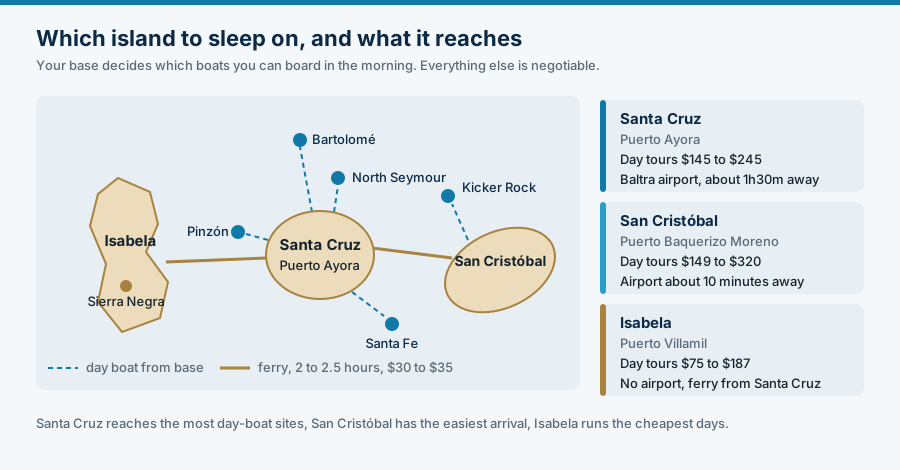
Position is the real advantage. Sitting in the centre of the archipelago, Santa Cruz puts more islands inside day-boat range than anywhere else: Pinzón, Santa Fe, Bartolomé, North Seymour, Floreana and even Isabela as a long day trip. If you only get one base, this is the one that gives you options when weather or availability changes your plans.
The highlands are the other reason. A short drive up from town takes you into misty farmland where wild giant tortoises move through the pasture on their own terms, past collapsed lava tunnels you can walk through. Of the 20,000 to 25,000 giant tortoises left across the archipelago, this is the population you can reach most easily without a breeding centre.
Price helps too. Budget rooms start around $30 to $65, mid-range runs $65 to $150, and the street kitchens beat the hotel restaurants. Full cost detail sits in the Galapagos cost breakdown.
What is San Cristóbal like as a base?
San Cristóbal is the calmer alternative with the best wildlife access on foot. Sea lions occupy the town beaches and the harbour steps, the airport is ten minutes from your hotel, and Kicker Rock is one of the best snorkelling sites in the islands. Day-tour variety is narrower than on Santa Cruz.
Puerto Baquerizo Moreno is the provincial capital and feels like a town where people live rather than one built for visitors. Galapagos sea lions haul out on Playa Mann and along the malecón in numbers that stop being remarkable by day two, and pupping peaks in August and September. The two-metre distance rule applies here more than anywhere, because the animals will not keep it for you.
On a short trip the airport matters. Reaching your hotel ten minutes after landing gives you back half of the arrival day a Baltra landing eats, which counts when you are working out how many days you need.
Kicker Rock, León Dormido on the charts, is the marquee excursion: two vertical tuff towers rising from open water with a channel between them, patrolled by hammerheads, Galapagos sharks and turtles. The full San Cristóbal 360 tour circles the island in nine hours with snorkelling at the rock, from around $270, and you can check live availability & prices on Viator. Shorter and cheaper versions exist across the San Cristóbal day tours list if nine hours on a boat sounds like too much.
What is Isabela like as a base?
Isabela is the biggest island and the smallest town. Puerto Villamil has sand streets, a flamingo lagoon, a tortoise breeding centre and the cheapest excursions in the archipelago, plus Sierra Negra volcano and the Los Túneles snorkelling site. Accommodation is limited and you can only arrive by ferry.
The landscape is the argument for Isabela. Sierra Negra has one of the largest volcanic calderas on earth, and the hike out to its rim is a half-day rather than an expedition. Los Túneles at Cabo Rosa is a maze of collapsed lava arches in shallow water, full of turtles, rays and white-tipped reef sharks. Galapagos penguins nest in this part of the archipelago, with nesting possible anywhere from May to December.
Isabela is also where the day-tour price band drops. Excursions run $75 to $187, against $145 to $245 from Santa Cruz, because the sites are close and several are land-based. If your budget is under pressure by the second half of a trip, moving to Isabela is the single most effective adjustment you can make.
The trade-offs are real. You arrive by lancha, 2 to 2.5 hours from Santa Cruz for $30 to $35, and hotel stock is thin in July, August and around the New Year. Nightlife amounts to a few bars on the beach. Some visitors call it the best three nights of the trip; others get restless by day two.
| Day trip from your base | Santa Cruz | San Cristóbal | Isabela |
|---|---|---|---|
| Pinzón Island snorkelling | Yes | No | No |
| Santa Fe Island | Yes | No | No |
| Bartolomé and Pinnacle Rock | Yes, long day | No | No |
| North Seymour | Yes | No | No |
| Kicker Rock | No | Yes | No |
| Isabela: Tintoreras and wetlands | Yes, long day | No | Yes, on your doorstep |
| Sierra Negra volcano | No | No | Yes |
| Los Túneles / Cabo Rosa | No | No | Yes |
| Highlands tortoise reserves and lava tunnels | Yes | Yes, own version | Yes, breeding centre |
Which island suits which kind of traveller?
First-timers and anyone on a short trip should base on Santa Cruz. Families with young children and wildlife photographers often do better on San Cristóbal. Hikers, budget travellers and second-time visitors get more from Isabela. Divers should base wherever their operator runs, usually Santa Cruz or San Cristóbal.
| You are | Base on | Why |
|---|---|---|
| A first-time visitor with 5 nights | Santa Cruz | Most day tours, most fallback options if weather closes a boat |
| Travelling with young children | San Cristóbal | Sea lions and beaches on foot, ten-minute airport transfer |
| On a tight budget | Isabela | Excursions from $75, and free sites within walking distance |
| A hiker wanting a volcano | Isabela | Sierra Negra caldera, half-day hike from town |
| A photographer chasing wildlife on foot | San Cristóbal | Sea lion colonies in town, pupping peak in August and September |
| A certified diver | Santa Cruz or San Cristóbal | Dive operators and permitted sites cluster on both |
| Returning for a second trip | Isabela | You have already done the Santa Cruz highlands |
| Short on time and unwilling to move hotels | Santa Cruz | Reaches Isabela, Bartolomé and North Seymour as day trips |
How should you split a week across two islands?
Four nights on Santa Cruz and three on Isabela is the standard seven-night split, using one ferry each way. It gives you the highlands, one or two snorkelling boat days, the volcano and the lava tunnels. Adding San Cristóbal properly needs ten nights, not seven.
The constraint is the ferry map. Santa Cruz sits in the middle, so any two-island pairing that includes it costs you one crossing each way. Pairing Isabela with San Cristóbal costs you two crossings in each direction, since there is no direct service, and that is most of two days gone from a seven-night trip.
| Nights | Split | Ferries | What you cover |
|---|---|---|---|
| 5 | Santa Cruz only | None | Highlands, one big boat day, Tortuga Bay |
| 7 | 4 Santa Cruz, 3 Isabela | 2 | Adds volcano, Los Túneles, penguins, flamingos |
| 7, alternative | 4 Santa Cruz, 3 San Cristóbal | 2 | Adds Kicker Rock and sea lion colonies |
| 10 | 4 Santa Cruz, 3 Isabela, 3 San Cristóbal | 4 | All three inhabited islands |
| 10, open-jaw | Fly into Baltra, out of San Cristóbal | 3 | Removes one crossing, saves half a day |
One practical tip that saves a crossing: book an open-jaw flight, arriving at Baltra for Santa Cruz and departing from San Cristóbal. Airlines price island routes as separate legs, so this rarely costs more, and it turns a there-and-back itinerary into a loop. If you are still deciding between staying ashore at all and taking a cabin, the cruise versus land-based comparison settles that question first, and the Conservancy's planning notes are worth a read alongside it.
Can you stay on Floreana?
Yes, in a very small way. Floreana has a tiny resident population and a handful of guesthouses, and it works as an overnight or a day trip from Santa Cruz rather than a base. Ferry connections are limited and infrequent.
Do I need to book Isabela hotels in advance?
In high season, yes. Puerto Villamil has the smallest room stock of the three towns and it sells out. Outside the peak months you can usually arrive and find something, but the good places still go first.
Which island has the best snorkelling?
They differ rather than rank. San Cristóbal has Kicker Rock for sharks and open-water drama. Isabela has Los Túneles for turtles and rays in calm shallow water. Santa Cruz reaches Pinzón and Santa Fe, which are the most reliable all-round snorkelling day boats.