When Is the Best Time to Visit the Galapagos?
There is no bad month in the Galapagos, but there are months that suit you badly. The difference comes down to water temperature, sea state and which animals are doing something.
 Written with Oleg Galeev, Galapagos travel writer, three trips to the islands
Short answer
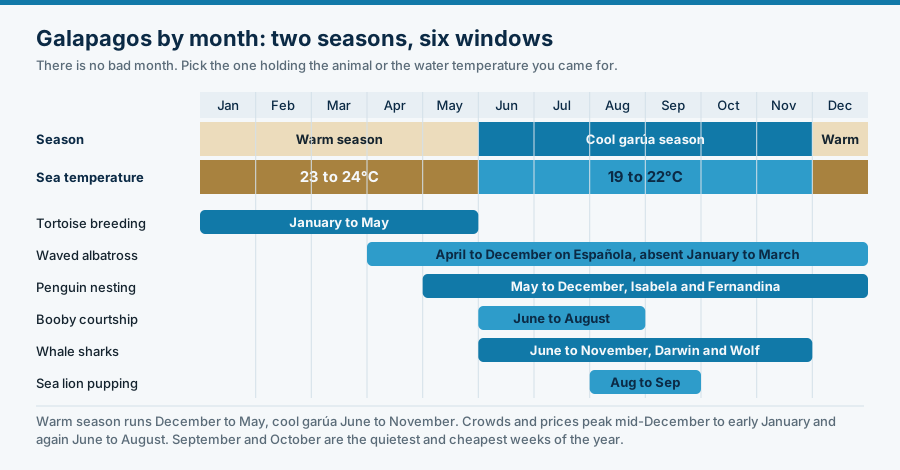
There is no closed season. December to May is the warm season with sea temperatures around 23 to 24°C, calmer water and short heavy showers. June to November is the cool garúa season, 19 to 22°C in the water, greyer skies, choppier crossings and the richest marine feeding. Pick by wildlife and water temperature, not by rainfall.
The sea here swings by roughly five degrees Celsius across the year, and that single number decides more about your trip than the name of any month. I have been to the islands three times and the thing I remember most clearly is not weather at all, it is how differently the same stretch of water behaves. Warm and glassy on one visit, cold and full of life on another. Nobody tells you that when they hand you a calendar of average temperatures.
Is there a bad month to visit the Galapagos?
No month is closed, and no month is empty of wildlife. The archipelago sits on the equator, so daylight barely changes and animals stay resident year-round. What changes is sea temperature, sea state and which species are breeding, and those differences are large enough to reshape your trip.
The islands run on two seasons rather than four, and the naming is genuinely useful. From December to May the warm season brings hotter air, sea temperatures around 23 to 24°C, calmer crossings and short intense showers that usually clear by afternoon. From June to November the cool garúa season takes over, named after the fine coastal mist that hangs over the highlands. Sea temperature drops to roughly 19 to 22°C, skies grey over, and the Humboldt Current pushes nutrient-rich water up from the south.
That upwelling is the reason experienced visitors often prefer the season that sounds worse on paper. Cold water means plankton, plankton means fish, and fish mean everything else. Sea lions hunt harder, seabirds feed closer to shore, and the snorkelling gets busier under the surface even as the sky above it turns flat.
| Warm season, December to May | Cool garúa season, June to November | |
|---|---|---|
| Sea temperature | About 23 to 24°C | About 19 to 22°C |
| Wetsuit | Optional for most people | Recommended, usually provided |
| Sky | Bright, with short heavy showers | Overcast, fine drizzle in the highlands |
| Sea state on crossings | Generally calmer | Choppier, windier |
| Underwater visibility | Clearer on average | More plankton, more marine action |
| Suits | Swimmers, families, photographers wanting blue skies | Snorkellers, divers, seabird watchers |
Which month is the wettest, and when should you not go?
The heaviest rain falls in the middle of the warm season, typically February and March, arriving as short tropical downpours rather than all-day rain. Avoid January to March if the waved albatross is on your list, since the entire colony is away at sea. Avoid June to November if cold water bothers you.
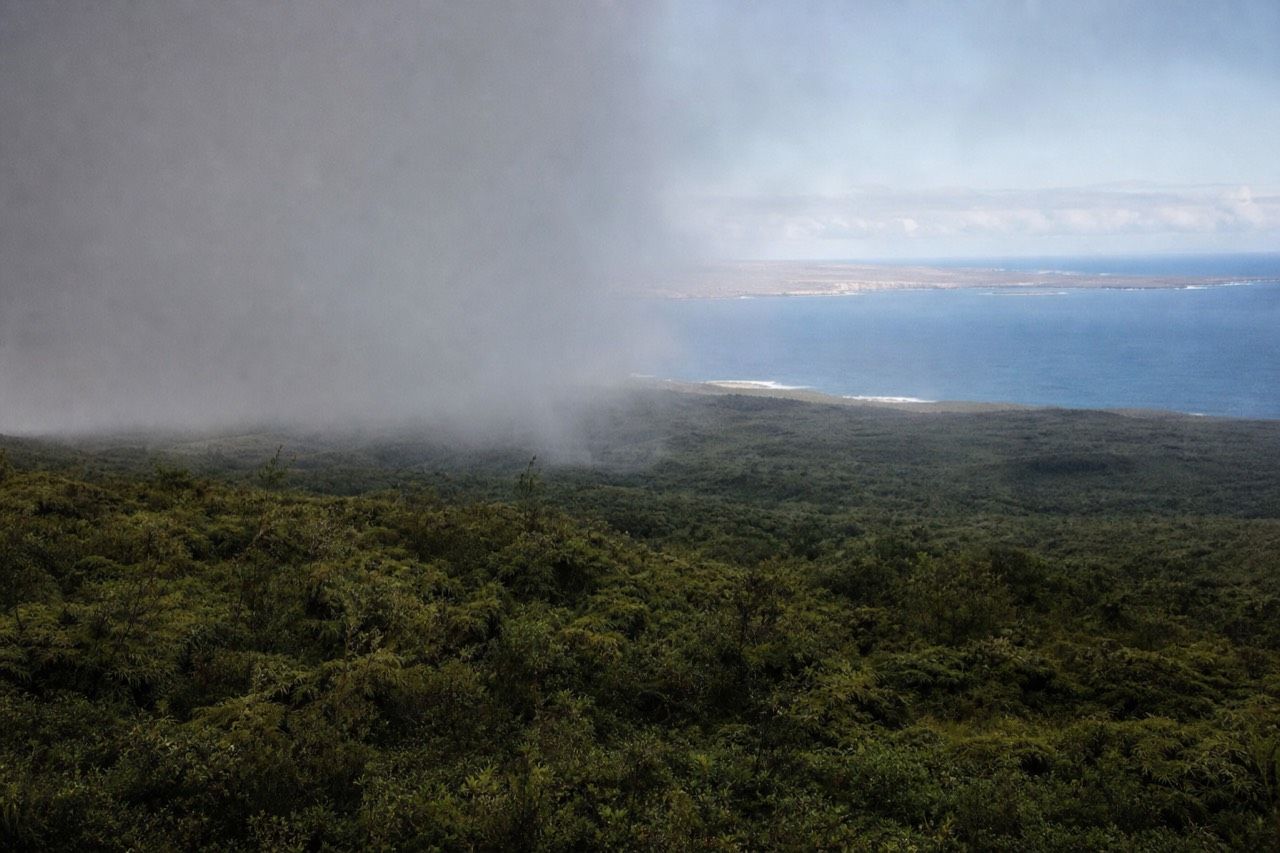
Rain here rarely cancels anything. A warm-season shower lasts twenty minutes, soaks the trail, and then the sun returns and dries you before you reach the boat. The garúa season produces far less measurable rain but far more grey, a persistent mist over the Santa Cruz highlands that can sit all day. If your mental image of the Galapagos is a blue sky over a white beach, the warm months deliver it more reliably.
The honest "do not go now" advice is species-specific rather than weather-specific. Waved albatross are on Española from around April to December or January and are absent from the island entirely between January and March, so a January trip built around them will fail. Blue-footed booby courtship, the foot-lifting dance everyone has seen in photographs, peaks between June and August and is much harder to catch outside that window.
What is the Galapagos wildlife calendar month by month?
Giant tortoises breed through the hot season from January to May. Blue-footed booby courtship runs June to August. Waved albatross occupy Española April to December. Sea lion pupping peaks in August and September. Whale sharks pass Darwin and Wolf June to November. Penguins nest across May to December.
That list is the real reason to pick a month. Everything else, the temperature and the cloud, is secondary once you know what you specifically want to see.
| Window | What is happening | Where it matters most |
|---|---|---|
| January to May | Giant tortoise breeding season, eggs hatching after about 130 days | Santa Cruz highlands, tortoise reserves |
| April to December | Waved albatross present and courting | Española |
| May to December | Galapagos penguin nesting possible | Isabela, Fernandina, Bartolomé |
| June to August | Blue-footed booby courtship and mating | North Seymour, Española |
| June to November | Whale sharks at Darwin and Wolf | Liveaboard dive routes only |
| August to September | Sea lion pupping peaks | San Cristóbal, Santa Fe, most beaches |
| Year-round | Penguins breed; marine iguanas, tortoises, sea lions resident | All inhabited islands |
Sea lion pupping is the one that surprises people. Beaches in late August and September fill with pups that have no fear of humans and every intention of investigating your camera bag. The two-metre rule still applies, and it applies to you even when the animal is the one closing the distance.
If snorkelling with sea lions is the whole point of your trip, the day boats out of Santa Cruz are the most reliable way to get there. A seven-hour run to Pinzón Island and La Fé Bay covers snorkelling and fishing in one day, and you can check live availability & prices on Viator for the dates you are considering. It is the best rated boat in our Santa Cruz day tours list, though like most island operators it shows its price in the booking flow rather than on a listing page.
When is the Galapagos busiest and most expensive?
Visitor numbers peak in the northern hemisphere summer, June to August, and again from mid-December through early January when Ecuadorian and North American holidays overlap. Flights and hotels rise hardest in those windows. April, May, September and October are the quietest and cheapest good months.
The archipelago received 290,404 visitors in 2025, up 4% on the previous year, and the pressure is not spread evenly across the calendar. Ecuadorians make up 38% of arrivals and travel heavily around national holidays, while Americans account for 29% and cluster into summer and Christmas. Add European and Australian visitors into the same July and August peak and you get boats that sell out weeks ahead.
| Period | Crowds | Prices | Practical effect |
|---|---|---|---|
| Mid-December to early January | Highest | Highest | Book flights and boats months ahead |
| June to August | High | High | Popular day boats sell out; best booby courtship |
| April to May | Low to moderate | Moderate | Warm water, calm seas, albatross arriving |
| September to October | Lowest | Lowest | Cool water, sea lion pups, easiest availability |
| February to March | Moderate | Moderate | Warmest water, wettest weeks, no albatross |
Cost is not only about season. The fixed charges, the $200 park fee and the $20 transit card, are the same in every month, and they are laid out fully in the full Galapagos cost breakdown.
So which month should you actually pick?
For warm water and blue skies, choose March or April. For the best marine life and the fewest people, choose September or October. For blue-footed booby courtship, choose June or July. For calm crossings with a young family, choose April or May.
I keep coming back to the same short answer when people ask me directly: April is the most balanced month in the Galapagos calendar. The water is still warm, the seas have settled, the albatross are returning to Española, and the July crowd has not arrived. September is the specialist's answer, colder and greyer but alive underwater, with sea lion pups on every beach and the lowest prices of the year.
| If your priority is | Go in | Why |
|---|---|---|
| Warmest snorkelling water | February to April | Sea around 23 to 24°C, no wetsuit needed |
| Marine life density | August to November | Cool nutrient-rich water, active feeding |
| Booby courtship displays | June to August | Peak mating window |
| Waved albatross | April to December | Colony present on Española |
| Sea lion pups | August to September | Pupping peak |
| Lowest prices and crowds | September to October | Off-peak flights and hotels |
Whatever month you land in, the shape of the trip matters as much as the timing. Work out how many days you need first, because a well-planned five days in a mediocre month beats a rushed nine days in a perfect one.
Is the rainy season a reason to avoid the Galapagos?
No. Warm season rain comes in short heavy bursts, usually in the afternoon, and clears quickly. Day tours run through it. The greyer, drizzlier feel actually belongs to the cool garúa season, which produces less rain but more cloud.
Do I need a wetsuit for snorkelling?
Between June and November the water sits around 19 to 22°C and most people want one. Operators usually include a shorty or full wetsuit in the day tour price. In the warm season many swimmers manage without.
Which month has the best underwater visibility?
Visibility is generally clearer in the warm season, December to May, because there is less plankton in the water. The cool season trades some clarity for far more marine activity, which is why many divers prefer it anyway.
Can I see giant tortoises at any time of year?
Yes. Tortoises are resident and visible year-round in the Santa Cruz highlands and at breeding centres. What changes is behaviour: the hot season from January to May is when breeding happens, with eggs hatching roughly 130 days later.