How Many Days Do You Need in the Galapagos?
Count the days you can actually put on a boat, not the nights on your booking confirmation. They are rarely the same number.
 Written with Oleg Galeev, Galapagos travel writer, three trips to the islands
Short answer
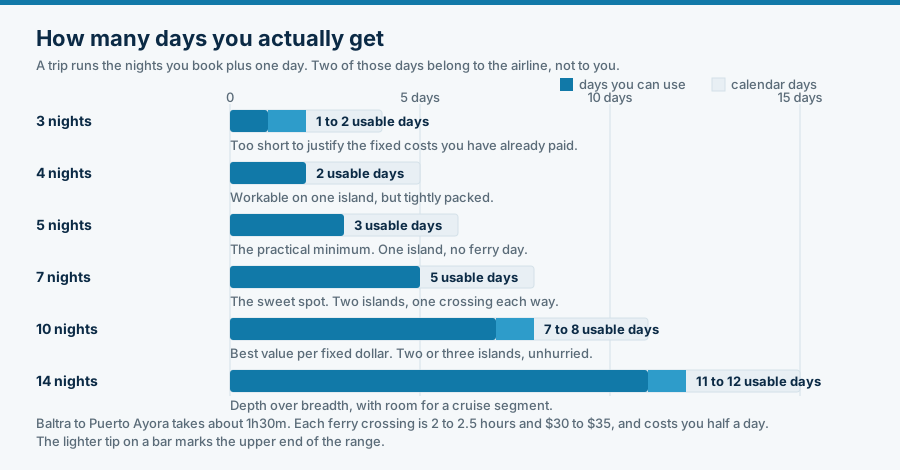
Five nights is the practical minimum and seven is the sweet spot. Your arrival and departure days are half-days at best, so a five-night trip yields about three full excursion days and a seven-night trip yields five. Add a day for every inter-island ferry, since each crossing takes 2 to 2.5 hours and usually kills a morning or an afternoon.
My flight out of Guayaquil left early, and before I could even check a bag I had to queue at the biosecurity desk to have it inspected and sealed. Then a two-hour flight, then a bus, then a ferry crossing the Itabaca Channel, then a taxi down to Puerto Ayora. By the time I dropped my bag at the hotel, the day was gone. That is the part nobody puts in an itinerary, and it is the reason most Galapagos trips are one day shorter than they look on paper.
How many days do you actually need in the Galapagos?
Five nights is the realistic minimum and seven is where the trip stops feeling rushed. Because arrival and departure days are consumed by flights, formalities and transfers, a five-night trip delivers roughly three usable excursion days, and a seven-night trip delivers five. Ten nights lets you cover two or three islands properly.
The arithmetic is simple once you accept the half-day rule. Whatever number of nights you book, subtract one day for arrival and most of another for departure. Then subtract half a day for every ferry crossing between islands. Whatever remains is your real supply of boat days, and boat days are what you flew here for.
That is also why very short trips disappoint people. Three nights sounds like a reasonable add-on to a mainland Ecuador holiday, and it buys you exactly one proper excursion after you have paid the $200 park fee and the $20 transit card to get through the door. The fixed costs do not shrink with the trip, which is laid out in full in the Galapagos cost breakdown.
| Nights booked | Usable full excursion days | Islands you can cover | Honest verdict |
|---|---|---|---|
| 3 | 1 to 2 | One | Too short to justify the fixed costs |
| 4 | 2 | One | Workable, but tightly packed |
| 5 | 3 | One, or two with one ferry | The practical minimum |
| 7 | 5 | Two comfortably | The sweet spot for most visitors |
| 10 | 7 to 8 | Two or three, unhurried | Best value per fixed dollar spent |
| 14 | 11 to 12 | Three plus a cruise segment | Only if you want depth over breadth |
Why do arrival and departure days not count as full days?
Arrival involves a mainland biosecurity inspection, a two to three hour flight, the park fee queue, a bus, a channel ferry and a road transfer. Departure requires you back at the airport hours before a mid-morning flight. Neither day supports a full-day excursion, and most operators will not sell you one on either.
The mainland end of it starts before you board. Ecuador runs a mandatory SICGAL and Agrocalidad baggage inspection at Quito and Guayaquil before check-in, and the list of restricted items covers fresh fruit, vegetables, seeds, plants and many animal products. Get to the airport early, because the queue is real and it is not optional.
Landing at Baltra adds its own sequence. Rangers collect the $200 park entrance fee in cash, then you take a shuttle bus to the Itabaca Channel, cross by ferry, and ride roughly forty-five minutes down the island to Puerto Ayora. San Cristóbal is far kinder: the airport is a short taxi ride from town.
| Stage of arrival day | Typical time cost |
|---|---|
| Biosecurity inspection at UIO or GYE, plus early check-in | 1 to 2 hours before departure |
| Flight, Guayaquil to the islands | About 1h55m to 2h |
| Flight, Quito to the islands via Guayaquil | About 3 hours total |
| Park fee and transit card processing on arrival | 20 to 45 minutes, longer on busy days |
| Baltra to Puerto Ayora, bus plus channel ferry plus road | About 1h30m |
| San Cristóbal airport to Puerto Baquerizo Moreno | About 10 minutes |
Departure day is shorter but no less destructive. Island flights to the mainland tend to leave in the morning, which means a dawn transfer back across the channel from Puerto Ayora. Book a day tour on that morning and you will miss the plane.
How much time do inter-island ferries really cost?
Each lancha crossing takes 2 to 2.5 hours and costs $30 to $35, but the real cost is the half-day it consumes. Boats run on fixed morning and afternoon departures, and there is no direct Isabela to San Cristóbal service, so that pairing costs you two crossings through Santa Cruz.
The two and a half hours in the boat is only part of it. You need to be at the dock ahead of departure, take a water taxi out to the lancha, then a water taxi back in at the far end, and then find your hotel. Rough water in the cool season stretches the crossing further. Plan a ferry morning as a ferry morning and nothing else.
| Route | Crossing time | One-way fare | Practical time lost |
|---|---|---|---|
| Santa Cruz to Isabela | 2 to 2.5 hours | $30 to $35 | Half a day |
| Santa Cruz to San Cristóbal | 2 to 2.5 hours | $30 to $35 | Half a day |
| Isabela to San Cristóbal | No direct service | $60 to $70 via Santa Cruz | A full day |
This is why two islands in five nights is possible but three is not. If you are weighing which pair to combine, the island base comparison sets out what each town gives you and which day tours leave from where.
What does a five-day trip look like in practice?
Five nights on one island gives you three excursion days: one big boat day, one land day in the highlands, and one flexible day for a beach, a shorter tour or bad weather. Basing on Santa Cruz makes this the strongest short trip, because it has the widest day-tour choice.
Here is the shape I would give a friend with five nights and no wish to spend them on ferries. Arrive at Baltra, base in Puerto Ayora, and never pack a bag again until you leave.
Day one is arrival and a walk into town. Day two is your marquee boat day, ideally out to a snorkelling island. Day three goes to the highlands: giant tortoises in the wild, a lava tunnel, a crater. Day four is the second boat day or a rest day at Tortuga Bay depending on how you feel. Day five is departure.
For that marquee day, the Santa Fe Island and Hidden Beach tour is the one I would point at first. Seven hours, snorkelling, fishing, endemic land iguanas and a beach most visitors never see, and you can check live availability & prices on Viator for your dates. It rates 4.9 across its reviews, though the review count on these island listings is modest because most Galapagos travel is still booked direct rather than through the big platforms. The full set of Santa Cruz day tours covers the shorter three-hour options for your flexible day.
What does seven days unlock that five does not?
Seven nights buys you a second island. The standard shape is four nights on Santa Cruz and three on Isabela, with one ferry between them, giving five excursion days across two very different landscapes: highlands and snorkelling on one, volcano and lava tunnels on the other.
The step from five to seven is the biggest single jump in trip quality, because it moves you from one island to two without turning the week into transit. Santa Cruz has the tortoise highlands, the Darwin Station and the widest boat choice. Isabela has the volcano, the penguins, the flamingo lagoons and the cheapest excursions in the archipelago.
Seven nights also gives you slack. Day boats get cancelled for weather, particularly in the windy months of the cool season, and a five-night trip has no room to absorb that. With seven you rebook and lose nothing.
| Trip length | Suggested split | What you get |
|---|---|---|
| 5 nights | 5 on Santa Cruz | Highlands, one or two boat days, Tortuga Bay |
| 7 nights | 4 Santa Cruz, 3 Isabela | Adds Sierra Negra, Los Túneles, penguins, flamingos |
| 10 nights | 4 Santa Cruz, 3 Isabela, 3 San Cristóbal | Adds Kicker Rock, sea lion colonies, a full 360 boat day |
| 10 nights, alternative | 5 nights cruise, 5 nights land-based | Adds Genovesa, Fernandina or Española |
Is ten days too long for the Galapagos?
No. Ten nights covers all three inhabited islands at a civilised pace and drops your cost per usable day sharply, since the park fee, transit card and flights are one-off charges spread across more days. It also opens the option of splitting the trip between a short cruise and a land base.
The fixed costs are the argument. Paying $200 and $20 and a $400 flight for three usable days is expensive per day. Paying the same for eight usable days is not. If time is available, longer is almost always better value here, which is the opposite of how most destinations work.
Where ten nights can go wrong is over-scheduling. Eight consecutive boat days is genuinely tiring, and there is a lot of sun, salt and early starts involved. Build in two unstructured days and use them for the free sites: Tortuga Bay, Concha de Perla, the Interpretation Centre. The Conservancy's planning notes make the same point about pacing. And if you are still deciding between formats, the cruise versus land-based comparison is the place to settle it before you count nights.
Can I visit the Galapagos as a day trip from mainland Ecuador?
No. Flights arrive mid-morning and leave the following morning at the earliest, and the $200 park fee plus $20 transit card apply regardless of length of stay. Three nights is the shortest trip that makes any financial sense, and even that is thin.
How many day tours should I book in a week?
Three or four across seven nights. More than that and the early starts stack up. Leave at least one day open for weather, tiredness or a beach you did not expect to love.
Should I book day tours before I arrive?
Book the marquee boat days ahead, especially in June to August and around the New Year, when popular boats sell out. Shorter highlands and bay tours can usually be arranged locally a day or two in advance.
Is it worth flying into one island and out of another?
Often, yes. Arriving at Baltra and departing from San Cristóbal removes one ferry crossing from a multi-island trip. Airlines price these open-jaw island routes reasonably, so check it before booking a return to the same airport.