Galapagos Tours for Seniors: What to Expect
The wildlife does not require you to be fit. Getting to it sometimes does, and the gap between those two things is what nobody explains before you book.
 Written with Oleg Galeev, Galapagos travel writer, three trips to the islands
Short answer
Land-based Galapagos travel suits older travellers far better than a cruise: you sleep in a hotel, choose each day's activity, and can skip a rough one. The physical barriers are wet landings from small pangas, boat swell on crossings, and unshaded volcanic trails. Highlands tortoise tours and sheltered bay trips avoid nearly all of it.
I have spent years cataloguing Galapagos cruise and tour listings for my own platform, and the phrase that appears in almost all of them is "wet landing". It sounds like a technical detail. What it means in practice is stepping off the side of an inflatable boat into knee-deep moving water, onto sand or lava, while the boat rocks and a guide holds your forearm. For a lot of people that is a non-event. For anyone with a hip replacement, poor balance or a bad knee, it is the single thing that decides whether a tour works.
Nobody tells you this at the booking stage. The listings say "moderate". This guide says what "moderate" actually involves, and which trips avoid it entirely.
Is the Galapagos realistic with limited mobility?
Yes, with the right structure. Land-based travel from a hotel base removes the daily transfer problem that makes cruises hard: you sleep on solid ground, pick each day from a menu, and skip anything rough without losing a paid excursion. Highlands tours, sheltered bay trips and town wildlife need very little physical capability.
The archipelago has quietly reorganised itself around this. Land-based travel is now how 79% of visitors see the islands, against 21% on cruises, and the day-tour market that grew up around it means you are no longer locked into a fixed twice-daily landing schedule.
That said, the Galapagos is not a soft destination. Docks have steps and no railings. Boats are boarded from floating water taxis. Trails cross broken lava. Nothing is impossible, but pretending it is all step-free helps nobody.
| Factor | Land-based | Cruise |
|---|---|---|
| Where you sleep | Hotel on solid ground | Cabin, moving all night |
| Daily activity | Chosen each day, skippable | Fixed itinerary, two landings a day |
| Getting ashore | Walk onto a pier or boat from a dock | Panga transfer at every stop |
| Wet landings | Avoidable on many tours | Frequent and often unavoidable |
| Rest day | Easy, town has plenty to do | You are still at sea |
| Medical access | Clinics in Puerto Ayora and Puerto Baquerizo Moreno | Ship first aid, evacuation if serious |
| Cost per day | About $250 to $350 mid-range | About $450 to $1,000 or more |
The comparison people expect to hear is that cruises reach more islands, which is true. The one they do not expect is that a cruise commits you to a panga transfer twice a day for a week with no opt-out that does not mean sitting on the boat. Cruise versus land-based covers the full trade, but on mobility grounds alone the land-based case is strong.
What is a wet landing, and how hard is it?
A panga, the small inflatable tender, runs its bow onto a beach. You swing your legs over the side, step down into water that is usually shin to knee deep, and walk ashore on sand or rock. The boat moves. A guide steadies you. It takes about ten seconds and it is the most common reason older travellers turn back.
Dry landings exist too, where the panga ties to a rock ledge or a small jetty and you step across. They are easier, but the step can be uneven and the gap opens and closes with the swell.
| Transfer type | What it involves | Main difficulty |
|---|---|---|
| Dry landing at a jetty | Step across a moving gap onto a fixed step | Timing the swell, uneven height |
| Wet landing on a beach | Step down into shin to knee-deep water | Balance on a moving boat, soft sand |
| Water taxi in harbour | Step down into a small boat at a dock | Short drop, usually handrails, calm |
| Boarding a day boat from a pier | Step across, sometimes a short ladder | Fine for most, steep at low tide |
| Snorkel entry from the boat | Ladder down into open water | Getting back up the ladder, not down it |
The ladder is worth flagging. Climbing out of the sea in a wetsuit, with fins, on a rocking boat, is more physically demanding than any part of the snorkel itself. Shoulder strength matters here more than swimming ability.
Which Galapagos day tours are genuinely gentle?
Highlands tortoise and lava tunnel tours involve no boat at all: a vehicle, a farm track, level ground and a short walk. Half-day bay tours around Puerto Ayora stay in sheltered water with a dry boarding from the pier. Both run about three hours. Everything offshore is a step up in effort.
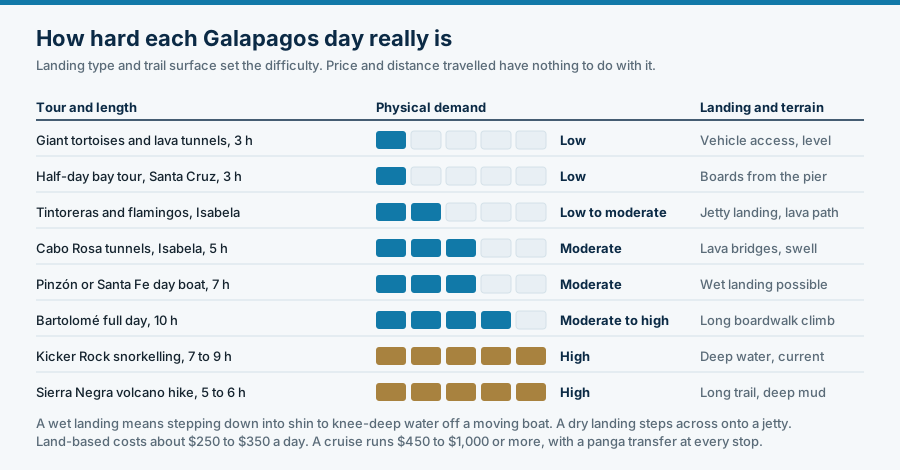
Here is the honest ranking of what we link, judged on physical demand rather than scenery.
| Tour | Length | Landing | Terrain | Physical demand |
|---|---|---|---|---|
| Giant tortoises and lava tunnels, Santa Cruz | 3 hours | None, vehicle access | Level farm ground, tunnel steps | Low |
| Half-day bay tour, Santa Cruz | 3 hours | Boat from pier, no beach landing | Boat deck, optional swim | Low |
| Tintoreras and flamingos, Isabela | Half to full day | Short boat, jetty landing | Lava path, uneven underfoot | Low to moderate |
| Cabo Rosa tunnels snorkelling, Isabela | 5 hours | Boat, some walking on lava bridges | Uneven volcanic rock, swell at the entry | Moderate |
| Pinzón or Santa Fe day boat | 7 hours | Wet landing possible | Beach, snorkel entries | Moderate |
| Bartolome full day | 10 hours | Dry landing, then a long boardwalk climb | Hundreds of steps to the viewpoint | Moderate to high |
| Kicker Rock snorkelling | 7 to 9 hours | No landing, deep-water snorkel | Open ocean, current | High |
| Sierra Negra volcano hike | 5 to 6 hours | None, trailhead by vehicle | Long unshaded trail, loose rock, deep mud after rain | High |
Sierra Negra gets oversold as an easy walk. The operator lists it at five to six hours, and that time is spent almost entirely on foot, on an exposed volcanic trail that turns to sticky mud in the wet months. There is no shortcut back. If you are unsure about a long walk in equatorial sun, this is the tour to skip rather than the one to attempt.
Bartolome is the interesting borderline case. The landing is dry and the boat is comfortable, but the viewpoint is reached by a long wooden staircase up the side of a cinder cone. Plenty of people in their seventies do it steadily. Plenty of others stay at the beach and snorkel instead, which the boats accommodate without fuss.
The gentlest genuinely wild experience in the islands is the Santa Cruz highlands. Giant tortoises graze the farms year-round, entirely wild, and you walk to them across flat pasture from a vehicle. A short trip like the giant tortoise and lava tunnels tour takes about three hours from Puerto Ayora with no boat involved at all. Read the operator's inclusions and check live availability & prices on Viator. If you want to compare it against the sheltered boat options, the Santa Cruz day tours page has the full set.
How rough is the sea, really?
Rougher than the photographs suggest. The inter-island lanchas are small speedboats crossing open ocean for two to two and a half hours at speed, slamming over swell. Day-tour transits to offshore islands run one to two hours each way. Motion-sickness medication taken an hour before departure is normal practice, not overcaution.
This is the part I would weigh most heavily. Swell does not care how fit you are, and a bad crossing can cost you the following day as well.
Two structural fixes work. First, minimise island changes: one ferry crossing in a week is plenty, and staying on Santa Cruz for the whole trip removes them entirely while keeping the widest tour choice. Second, choose the morning boat, when the sea is usually calmer than in the afternoon. Which island to base yourself on goes through what each one gives up.
On the boat itself, sit low and central rather than in the bow, stay on the open deck if there is one, and keep your eyes on the horizon. Anyone prone to seasickness should treat the lancha crossings as the thing to plan around, not an incidental transfer.
What should older travellers pack differently?
Grip and stability, not gear. Closed-toe water shoes with a real sole handle wet landings and lava far better than sandals. A collapsible trekking pole helps on uneven ground and packs flat. Bring enough of any prescription medication for the whole trip, because island pharmacies are limited.
Two more that matter here specifically. A wide-brim hat, because there is almost no shade on the trails and the equatorial sun at sea level is relentless. And a dry bag, because every boat day soaks something, and losing a phone or a hearing aid to spray is an avoidable trip-ruiner. The full packing guide has the rest, including the biosecurity items that get confiscated before you fly.
Altitude deserves a mention if you are routing through Quito, which sits at around 2,850 metres. Anyone with a heart or lung condition may find Guayaquil at sea level the easier staging point for the island flight.
What do you need to know about guides and the rules?
Every visit to a protected site happens with a national park-authorised naturalist guide, and groups move together at the guide's pace. Tell the operator about mobility limits when you book, not on the morning. Guides adapt routes and hold arms at landings routinely, but only if they know.
The park's requirements are set out in its visitor rules, which also include the 2 metre distance from all wildlife. That one occasionally works in your favour: since animals here do not flee, you rarely need to scramble anywhere for a view. A Galapagos giant tortoise will sit in a highland field and ignore you for as long as you care to watch.
Group size is the other thing to ask about. Smaller boats move at the pace of their slowest passenger far more comfortably than large ones, and where a listing shows no price, the cost appears in the booking flow once you enter dates and party size. Ask directly about the landing type for the specific date, because some sites switch between wet and dry landings depending on tide and swell.