Why Are the Blue-Footed Booby's Feet Blue?
The blue comes from the fish they eat, it fades within days of a bad feeding run, and females read it. How booby feet work, how to tell the three Galapagos species apart, and where to watch the courtship dance.
 By Oleg Galeev, Galapagos travel writer, three trips to the islands
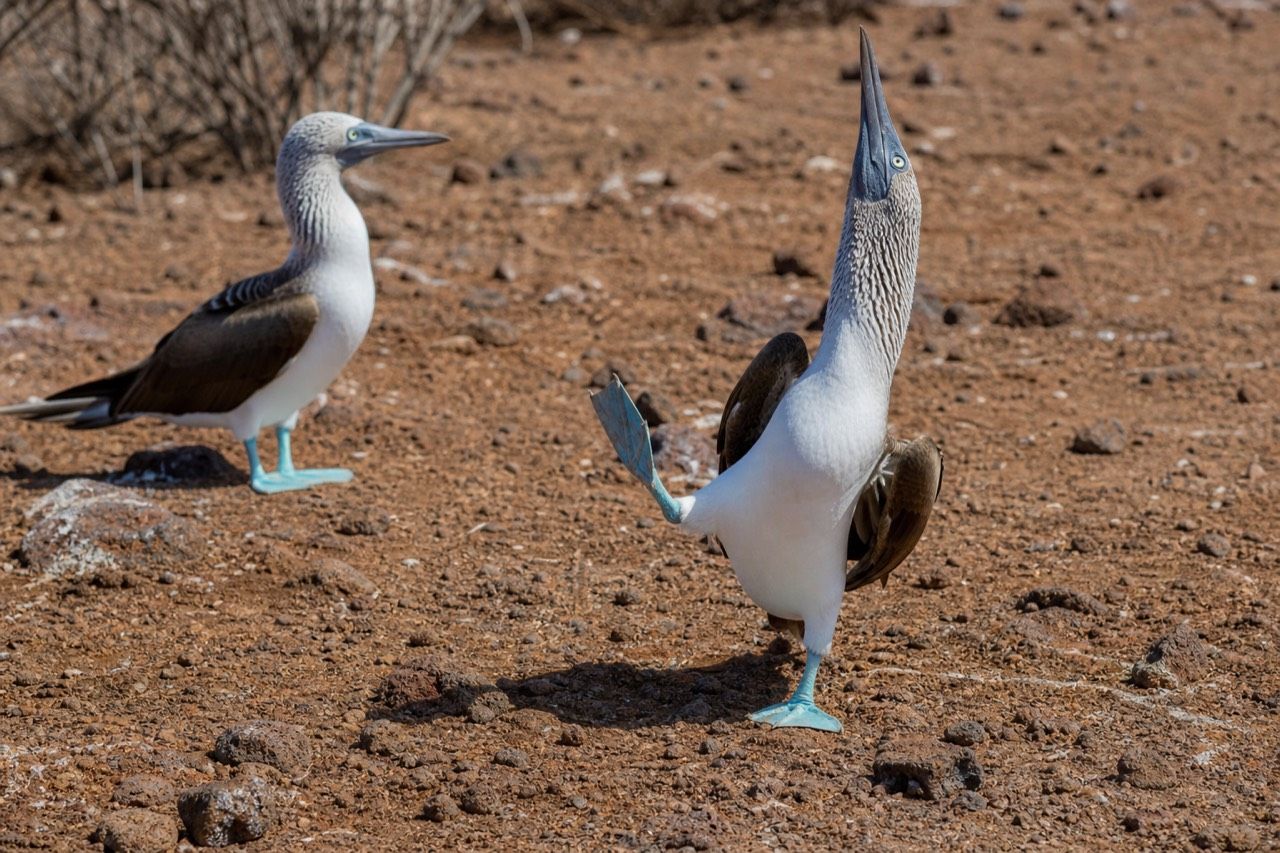
The blue is not decoration and it is not permanent. A blue-footed booby's feet are a live readout of how well that bird has eaten in the last few days, and they fade when the fishing goes badly. Of every wildlife question people bring to the Galapagos, this is the one that comes up most, and it came up over and over on the cruise I booked in 2023. The short answer surprises people, because it turns a comic-looking bird into one of the more precise pieces of biology you can watch from six feet away.
Why are blue-footed booby feet actually blue?
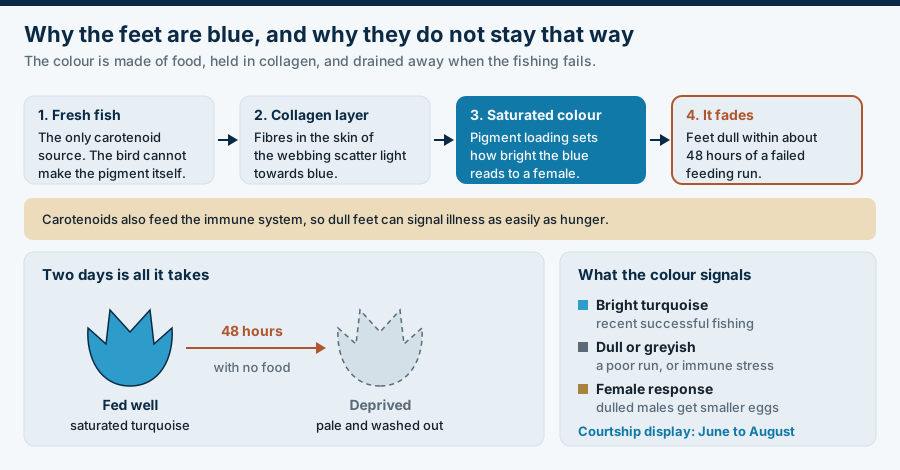
The colour comes from carotenoid pigments the bird gets only from fresh fish, sitting in a layer of collagen fibres in the skin of the webbing. Carotenoids cannot be made internally, so the brightness of a booby's feet tracks how much good food it has caught recently. Feet dull when feeding fails.
Two things combine to make the shade. The collagen structure in the foot scatters light towards the blue end, which is why the base colour is turquoise rather than yellow, and dietary carotenoids saturate it. Those pigments do double duty in the bird's body, because they also feed the immune system. A booby that is fighting something off spends its carotenoids on that instead of on its feet, which means dull feet can signal illness as easily as hunger.
The experiment that settled this is unusually clean. Researchers withheld food from adult males for 48 hours and measured the feet before and after. The colour had noticeably faded by the end of that short window, and it recovered once the birds fed again. Nothing else about the bird changes that fast. The Galapagos Conservation Trust's species page is a good, unhyped summary if you want the wider ecology behind that finding.
| Observation on the bird | What it is linked to |
|---|---|
| Bright, saturated turquoise feet | Recent successful fishing and a good carotenoid supply |
| Dull, greyish or pale feet | A poor feeding run in the last few days, or immune stress |
| Feet fading within 48 hours | Food deprivation, demonstrated experimentally in adult males |
| Older males duller on average | Age-related decline in condition, which females respond to |
| Colour recovering after feeding | The signal resets, which is what makes it honest |
What do females do with that information?
Females read foot colour before mating and adjust their investment accordingly. Studies have found that when a male's feet are experimentally dulled, his partner lays smaller eggs. The signal is hard to fake, because it depends on food the male must catch himself, which is exactly what makes it useful.
This is the part that turns the courtship dance from slapstick into something worth standing still for. A displaying male lifts one foot, then the other, slowly, holding each up long enough for it to be looked at properly. He sky-points, tipping his bill and tail vertically while whistling. He presents nest material, often a single unimpressive twig or pebble, which the female may accept or ignore. The whole performance is built around making the feet visible.
Pairs go through a version of this every season, not just the first time. Booby pairs are seasonally monogamous rather than bonded for life, and a female arriving to breed is assessing the current condition of a male she may have bred with before. Foot colour gives her a reading from the last few days, not the last few years.
| Feature | Male | Female |
|---|---|---|
| Call | A thin whistle | A deeper honk or grunt |
| Size | Slightly smaller and lighter | Larger, heavier, better able to dive deep |
| Pupil | Looks smaller, ringed by more pigment | Looks larger |
| Role in display | Does most of the foot lifting and sky-pointing | Assesses, then joins in |
| Tail | Longer relative to body, used in hovering dives | Shorter |
How do you tell blue-footed, Nazca and red-footed boobies apart?
Feet are the giveaway but not the only one. Blue-footed boobies are brown above with a streaked head and turquoise feet, and nest on open ground. Nazca boobies are clean white with black wing edges and an orange bill. Red-footed boobies are the smallest and the only one that nests in trees.
Once you have seen all three, the confusion disappears. From a moving panga it is easier to use the nest than the bird. Blue-footed boobies sit on flat, open ground inside a neat ring of white guano that the sitting bird sprays outward, which is why their nests look drawn on. Nazca boobies choose cliff edges and bare terraces. Red-footed boobies perch and nest in mangroves and palo santo, gripping branches with feet that are built for it.
Nazca boobies also do something that upsets visitors when a guide explains it. The female lays two eggs several days apart, and the first chick to hatch pushes the second out of the nest scrape. It happens every time, not occasionally. Blue-footed boobies do the same thing only when food is short, which loops back to the same carotenoid economy that colours the feet.
| Species | Feet | Plumage and bill | Nests | Typical Galapagos sites |
|---|---|---|---|---|
| Blue-footed booby | Turquoise to pale blue | Brown above, streaky brown head, grey bill | Bare open ground, ringed with guano | North Seymour, Kicker Rock, Española, Isabela cliffs |
| Nazca booby | Dull grey-green | White with black trailing wing edges, bright orange bill | Cliff edges and rocky terraces | Española, Genovesa, Punta Pitt |
| Red-footed booby | Bright red or pink | Two morphs, brown or white, blue and pink bill base | In trees and shrubs, the only booby that does | Genovesa, Punta Pitt on San Cristóbal |
When and where should you go to see the courtship dance?
Courtship and mating run from June to August, which is the window where the foot lifting and sky-pointing are worth planning around. Blue-footed boobies are present year-round, so you will see the birds in any month. You just will not see the display outside the breeding push.
North Seymour is the site most people end up on, because the trail runs straight through nesting ground and the birds ignore you completely. It is a short crossing from the Baltra channel, which makes it one of the few high-value seabird sites reachable on a day boat rather than a cruise. If your priority is boobies rather than beaches, a North Seymour day trip is the single best half-day use of your time on Santa Cruz, and you can check live availability & prices to see what is running on your dates.
Two things to know before you go. The park's two-metre distance rule applies even when a bird walks towards you, which they do, and the official visitor rules put the responsibility on you to back off rather than on the bird. Second, nests are often on the path itself and are marked only by that guano ring. Guides will stop the group rather than step around them.
| Site | How you get there | Which boobies | Best months for display |
|---|---|---|---|
| North Seymour | Day boat via the Baltra channel from Santa Cruz | Blue-footed, plus frigatebirds | June to August |
| Kicker Rock, San Cristóbal | Day boat from Puerto Baquerizo Moreno | Blue-footed and Nazca on the cliff faces | June to August, viewed from the water |
| Punta Pitt, San Cristóbal | Long day boat or cruise stop | All three species in one location | June to August |
| Española, Punta Suárez | Cruise itineraries only | Blue-footed and Nazca, plus waved albatross April to December | June to August overlaps both |
| Genovesa | Northern cruise loop only | Red-footed and Nazca | Year-round nesting activity |
Is the name really an insult?
Yes, indirectly. "Booby" comes from the Spanish bobo, meaning foolish or clownish, applied by sailors to birds that had no fear of humans and were easy to catch. The name says more about the sailors than the bird, which is a precise, high-speed plunge diver.
Watch a feeding flock and the clumsy reputation collapses. Boobies fold their wings back and enter the water in a spear shape, with air sacs in the skull absorbing the impact and nostrils sealed permanently shut, so they breathe through the corners of the mouth. Groups hit the water together in a way that looks choreographed. Females dive deeper, males work shallower water, and a pair can therefore feed the same chick from two different parts of the water column.
If you are trying to photograph any of this, the display is slow and the diving is not, and those need completely different settings. Our notes on Galapagos photography cover the practical side. For choosing dates around wildlife more broadly, the best time to visit lays the seasons out month by month, and wildlife tours compares which day boats actually reach the seabird sites rather than just the beaches.
Do blue-footed boobies live only in the Galapagos?
No. They range along the Pacific coast from Mexico to Peru. A large share of the world's breeding pairs nest in the Galapagos, which is why the islands are the place people associate with them.Are their feet blue from birth?
No. Chicks and juveniles have dull, pale feet. The colour develops with maturity and then varies through adult life with diet and condition.What is the difference between a booby and a gannet?
They belong to the same family. Gannets are the cold-water members of the group and boobies are the tropical ones. The plunge-diving technique is essentially the same.Can I see the courtship dance in December?
It is much less likely. Courtship concentrates from June to August. Outside that window the birds are still present and visible, but the foot-lifting display is sporadic.How close can I get?
Two metres, or about six feet, is the minimum distance required at all times, including when a bird approaches you. Nesting birds on or beside the trail are the reason guides keep groups tightly grouped and moving.The best thing about the feet is that they are honest. A bird cannot borrow, fake or save up that colour. It shows what it caught this week, in full view, to anyone watching, which is more than most signalling systems manage.