Is the Galapagos Welcoming for LGBTQ+ Travellers?
Ecuador has had marriage equality since July 2019 and constitutional protection from discrimination on sexual orientation. What that means in practice on small islands, small boats and small hotels, including where the law still falls short.
 By Oleg Galeev, Galapagos travel writer, three trips to the islands
Ecuador legalised same-sex marriage on 8 July 2019, following a Constitutional Court ruling the month before. That fact does a lot of work in answering this question, and it also does not answer it completely, because a legal framework in Quito and a fourteen-person day boat off Santa Cruz are two different environments. The Galapagos is not a destination with a scene. It is a set of three small towns and a lot of water, and what travellers usually want to know is more specific than "is it safe": will a hotel query the booking, will a boat crew make an issue of it, and is there anything in the paperwork that could snag.
What is the legal position in Ecuador?
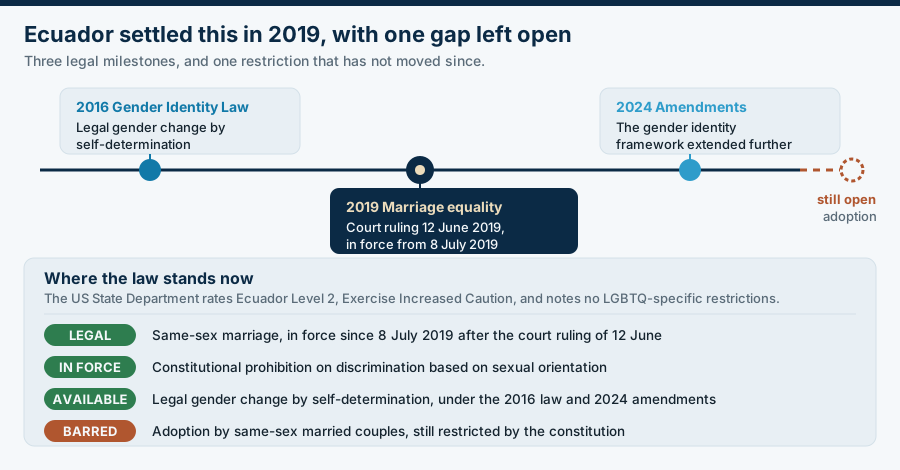
Same-sex marriage has been legal since 8 July 2019. The constitution prohibits discrimination on the basis of sexual orientation. A 2016 Gender Identity Law allows legal gender change by self-determination, extended by amendments in 2024. Adoption by same-sex married couples remains constitutionally barred, and that gap has not closed.
Ecuador is, on paper, among the more progressive countries in the region on these points. The marriage ruling came from the Constitutional Court rather than the legislature, which matters because it means the change rests on constitutional interpretation and is not easily undone by an ordinary law. The gender identity framework is separate and older, and lets people change the gender marker on national identity documents without a medical gatekeeper.
The adoption bar is the honest exception and worth stating plainly rather than skating over. The same constitution that prohibits discrimination also restricts adoption to different-sex couples, and courts have been pushed on the inconsistency without it being resolved. Human Rights Watch has documented the gap between the rulings and their implementation, which is a fairer summary than either the promotional or the alarmist version.
| Right or protection | Status | Detail |
|---|---|---|
| Same-sex marriage | Legal | Court ruling 12 June 2019, in force from 8 July 2019 |
| Protection from discrimination on sexual orientation | Constitutional | Written into the constitution |
| Legal gender change by self-determination | Available | 2016 Gender Identity Law, extended by 2024 amendments |
| Adoption by same-sex married couples | Still barred | A constitutional restriction that remains in place |
| General travel advisory | Level 2, Exercise Increased Caution | No LGBTQ-specific restrictions noted |
What are the islands actually like day to day?
Small, touristed and international. Puerto Ayora is a working town whose economy runs on visitors from dozens of countries, and hotel and boat staff deal with every configuration of traveller as routine. The smaller towns on San Cristóbal and Isabela are quieter and more conservative in feel, without being hostile.
There is no gay bar, no district, no Pride week in the archipelago. What there is instead is a heavily international visitor mix in a place where the day is structured around boats, guides and early starts. Social life on a Galapagos trip is largely group-based and activity-based rather than nightlife-based, which levels a lot of the usual variables.
The mainland is where visible community exists. Quito and Guayaquil have the venues and the annual Pride marches, and travellers who want that side of Ecuador usually build it into a stopover rather than expecting it in the islands. Our piece on flying via Quito or Guayaquil covers which of those cities is worth extra nights.
| Setting | What to expect |
|---|---|
| Puerto Ayora, Santa Cruz | The largest town, most international, hotels and operators used to every kind of booking |
| Puerto Baquerizo Moreno, San Cristóbal | Smaller and quieter, government town feel, no visible scene |
| Puerto Villamil, Isabela | The smallest and most rural of the three, sandy streets, very early nights |
| Small shared day boats | Mixed international groups of roughly ten to sixteen, guide-led, one shared day |
| Cruise vessels | Confined shared space for a week, cabin configuration is a booking question |
| Quito and Guayaquil | Where Ecuador's visible venues and Pride events are |
What should you actually check when booking?
Two things, mostly. Confirm bed configuration in writing, because small island hotels frequently default to twin beds and fixing it on arrival is harder than fixing it by email. And on budget cruises, ask how the operator handles shared cabins, since some pair solo travellers by gender.
Neither of those is specific to LGBTQ+ travellers in principle, and both are more likely to cause friction for them in practice. The shared-cabin question is the one that catches people out. Cheaper cruise fares are often built on the assumption that a solo booking will be matched with a stranger, and the matching rule is set by the operator, not by you.
Day boats are the simpler case. You are with the same ten to sixteen people for one day, in swimsuits and wetsuits, following a guide. There is nothing to negotiate and nothing to disclose. If you would rather test the water with a short outing before committing to a week aboard something, a half-day Santa Cruz bay tour is the low-commitment way to see how the small-group format suits you, and you can check live availability & prices for your dates. The full set of boats running from Puerto Ayora sits on our Santa Cruz day tours page.
| Question to ask | Why it matters | When to ask |
|---|---|---|
| Is the room a double or a twin? | Small island hotels often default to twin and rooms are limited | Before paying, in writing |
| How are shared cabins allocated? | Budget cruise fares may assume same-gender pairing of solo bookings | Before booking a shared-cabin rate |
| Is a single supplement available? | Removes the cabin-sharing question entirely | At quote stage |
| What is the group size on the day boat? | Ten to sixteen is typical and changes the social feel entirely | Before booking |
| Does the booking name match the passport? | Airlines and the park fee counter check the passport, not the booking | Before travel |
Is there anything in the paperwork to watch?
Only the ordinary thing: consistency. Your passport is the document that airlines, the biosecurity check and the park fee counter work from, and every booking should match it exactly. Ecuador's domestic gender identity law governs Ecuadorian ID documents, not your passport, so what matters is that your own documents agree with each other.
The Galapagos has more checkpoints than most destinations, which is why this is worth a paragraph. You register a Transit Control Card online before you fly, at $20 per person. Your baggage goes through a mandatory biosecurity inspection at Quito or Guayaquil. On landing at Baltra or San Cristóbal you pay the $200 park entrance fee, $100 for children under 12, in person to rangers. Each of those is a moment where a name mismatch creates friction, and none of them is a moment where anyone is examining your relationship.
| Checkpoint | What is actually checked | Note |
|---|---|---|
| Transit Control Card registration | Passport details, paid online in advance | $20 per person |
| Airline check-in on the mainland | Passport against the ticket name | Match the booking exactly |
| Biosecurity inspection | Baggage contents, not documents | Restricted food and plant items |
| Park fee counter on arrival | Passport and payment | $200 adult, $100 child under 12, cash |
| Hotel or vessel check-in | Passport for the guest register | Standard for all visitors in Ecuador |
What about general safety in Ecuador?
The US State Department places Ecuador at Level 2, Exercise Increased Caution, and lists no LGBTQ-specific restrictions. That rating covers the country as a whole and reflects crime conditions on the mainland rather than anything in the archipelago, which is among the calmer places in the Americas to walk around at night.
Read the current advisory rather than a summary of it, including any province-level detail, because that detail is revised more often than the headline level is. The considerations that apply to a mainland stopover are not the ones that apply on Santa Cruz.
In the islands themselves the practical risks are environmental rather than social: sun, rip currents, boat transfers in swell, and the two-metre wildlife distance rule that exists because the animals will not move out of your way. Solo travellers of any description tend to find the format easy, since almost everything happens in guided groups. Our solo travel notes go into that in more detail, and where to stay compares the accommodation on each island, including which places handle booking requests well.
Is homosexuality legal in Ecuador?
Yes. Same-sex relationships are legal, the constitution prohibits discrimination on the basis of sexual orientation, and same-sex marriage has been recognised since July 2019.Can same-sex couples get married in the Galapagos?
Marriage equality applies nationally, so it applies in the Galapagos province as it does elsewhere in Ecuador. Practical arrangements are a separate matter, since the islands have limited civil administration.Will a hotel question a same-sex couple booking one bed?
It is unlikely to be an issue, but small island hotels often default to twin-bed rooms and have few of each type. Confirm the configuration in writing when you book rather than on arrival.Are trans travellers likely to face problems at checkpoints?
The checkpoints in the islands are about passports, payment and baggage contents. The usual advice applies: keep your booking names consistent with your passport, and carry documentation for any medication.Is there any LGBTQ+ nightlife in the islands?
No. The three island towns are small and the evenings are quiet. Ecuador's visible venues and Pride events are in Quito and Guayaquil, which is a reason to build a mainland stopover into the trip.The realistic summary is that the Galapagos is neither a destination that celebrates you nor one that gives you trouble. It is a set of small towns where everyone gets up early to get on a boat, in a country whose law settled this question in 2019 and has one piece of unfinished business left.