Is the Galapagos Good for Families With Kids?
Children are cheaper here than almost anywhere: half price at the park gate. The hard part is not the money, it is the length of the boat days.
 Written with Oleg Galeev, Galapagos travel writer, three trips to the islands
Short answer
Yes, with planning. Children under 12 pay a US$100 national park fee instead of US$200, wildlife is unusually approachable, and short bay tours suit ages five and up. The limits are ten-hour boat days, open-ocean ferry crossings, and snorkelling in deep water, which realistically starts around age eight.
There is a stretch of the Tortuga Bay trail on Santa Cruz where the paving runs dead straight through scrub for two and a half kilometres with no shade at all. Every time I have walked it I have passed families, and the pattern is identical: the adults are wilting and the children are fine right up until they are catastrophically not. Then the beach appears, there are marine iguanas lying across the sand like discarded gloves, and everyone forgets the walk.
That is the Galapagos with kids in miniature. The wildlife does the work. The logistics are where a family trip succeeds or falls apart, and almost all of it comes down to how long you keep children on a boat.
What do children pay to enter the Galapagos?
Children under 12 pay a US$100 national park entrance fee instead of the US$200 adult rate. Anyone 12 or over pays full price. Everyone, regardless of age, pays the US$20 Transit Control Card, registered and paid online before you fly. Both are per person, with no family cap.
The fee doubled on 1 August 2024, and the child rate rose alongside it. The current schedule is published on the park's official fee page, which is the number to trust when a booking agent quotes something older.
That 12-year threshold matters more than it looks. A family with an 11-year-old and a 13-year-old pays $100 for one and $200 for the other, and the difference is one birthday.
| Party | Park fee | Transit cards | Fixed total at the gate |
|---|---|---|---|
| Two adults | $400 | $40 | $440 |
| Two adults, one child under 12 | $500 | $60 | $560 |
| Two adults, two children under 12 | $600 | $80 | $680 |
| Two adults, two teenagers (12+) | $800 | $80 | $880 |
Flights sit on top of that at roughly $250 to $600 per person round trip from Quito or Guayaquil, and children are rarely discounted much on the island routes. The fee and transit-card mechanics, including where and how you pay them, are covered in the entry rules and flights guide.
Which tours actually suit which ages?
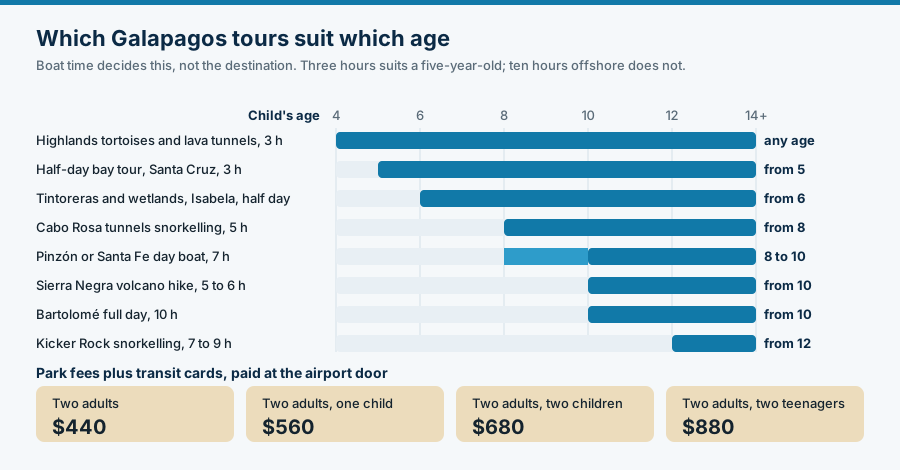
Under five, stay on land and in town. From five, three-hour bay tours in sheltered water work well. From eight, most full-day boats become realistic if the child can snorkel with a life vest. Ten-hour offshore tours like Bartolome suit confident swimmers from about ten upward.
Duration is the real filter, not the destination. A ten-hour tour means an early start, an hour or more of open-water transit each way, two water entries and a packed lunch on a moving deck. Some eight-year-olds handle that happily. Many do not.
| Tour type | Length | Works from about | Why |
|---|---|---|---|
| Half-day bay tour, Santa Cruz | 3 hours | Age 5 | Sheltered water, short transit, snorkel optional |
| Highlands tortoises and lava tunnels | 3 hours | Any age | Land only, short walks, no boat |
| Tintoreras and wetlands, Isabela | Half day | Age 6 | Calm channels, sharks visible from the path |
| Cabo Rosa tunnels snorkelling | 5 hours | Age 8 | Shallow but a proper open-water snorkel |
| Pinzón or Santa Fe day boat | 7 hours | Age 8 to 10 | Long, two snorkel stops, deeper water |
| Sierra Negra volcano hike | 5 to 6 hours | Age 10 | Long walk, exposed, often muddy |
| Bartolome full day | 10 hours | Age 10 plus | Early start, offshore transit, steep boardwalk climb |
| Kicker Rock snorkelling | 7 to 9 hours | Age 12 plus | Deep water, current, sharks, no standing depth |
Kicker Rock is the one to be honest about. It is a spectacular snorkel and it is also a vertical wall of rock dropping into deep blue water with current running through the channel. Children who are not strong, calm swimmers will not enjoy it, whatever the brochure says.
For a first boat day, the half-day bay tour on Santa Cruz is the sensible starting point: three hours around the sheltered bays near Puerto Ayora, with mask and fins included and no long offshore crossing. See what the operator includes and check live availability & prices on Viator. If it goes well, the longer boats on the Santa Cruz day tours page open up for the rest of the trip.
Does my child need to be able to snorkel?
Not for the trip as a whole, but yes for the tours built around it. Most day boats provide a wetsuit and a life vest, and the buoyancy does a lot of the work. A child who can put their face in the water and breathe through a tube calmly is ready. A child who panics with a mask on is not, and a boat deck is a bad place to find out.
Practise at home. Ten minutes in a swimming pool with a mask and snorkel, twice, removes most of the risk. Bringing a child-sized mask is worth the luggage space, because boat kits run adult-heavy and a leaking mask ruins the experience faster than cold water does.
Water temperature is the other factor. From June to November the sea sits around 19 to 22°C, cold enough that small bodies lose heat quickly even in a wetsuit. December to May brings roughly 23 to 24°C and much longer comfortable stints in the water. Families travelling with young snorkellers have a genuine reason to prefer the warm season, and the seasonal breakdown covers what else changes.
Sea lions are the great motivator. Young ones approach snorkellers, spin, and come back for more, and a child who was nervous at the ladder is usually impossible to get out of the water twenty minutes later.
How rough are the boats and ferries?
Rougher than families expect. The inter-island lanchas are small speedboats crossing open ocean for two to two and a half hours, and swell in the channels is normal rather than exceptional. Day-tour transits are shorter but still offshore. Motion-sickness medication, taken an hour before boarding, is standard practice here, not overcaution.
The lancha crossings between Santa Cruz and Isabela or San Cristóbal cost about $30 to $35 and are the least comfortable part of most family trips. Seats toward the middle and rear move less than the bow. Fresh air on the open back deck helps more than sitting inside.
| Crossing | Time | Motion | Family verdict |
|---|---|---|---|
| Santa Cruz to Isabela lancha | 2 to 2.5 hours | Often rough | Medicate in advance, morning boat |
| Santa Cruz to San Cristóbal lancha | 2 to 2.5 hours | Often rough | Same |
| Day tour transit, sheltered bays | 15 to 40 minutes | Mild | Fine for most children |
| Day tour transit, offshore islands | 1 to 2 hours each way | Moderate to rough | Age 8 plus, sit low and central |
| Water taxi in Puerto Ayora harbour | A few minutes | Flat | No issue |
One ferry per trip is a reasonable family limit. Two islands over seven nights works. Three islands with young children turns a holiday into a series of transfers.
How does the 2 metre wildlife rule work with children?
Visitors must stay at least 2 metres, about 6 feet, from every animal, even when the animal walks toward you. Children find this genuinely hard, because Galapagos wildlife has no fear response and a sea lion pup will approach a small human directly. The rule holds anyway, and guides enforce it.
Explain it before you arrive rather than on the beach. The framing that works with children is not "you will get in trouble" but "they are not scared of us, so it is our job to be careful". The park's visitor rules also cover feeding, touching and flash photography, all of which are prohibited, and drones are not permitted anywhere in the park or marine reserve.
August and September need extra care. That is the peak of Galapagos sea lion pupping, and bull sea lions patrolling a beach with pups on it are the one animal in the islands that will actively see off a person who gets too close. Keep children on the marked path and away from anything lying between them and the water.
Practical version of the rule: pick a landmark distance in advance. Two adult paces. Children manage a physical rule far better than an abstract one.
What are the calmer alternatives to a boat day?
Santa Cruz has a full day of free, land-based wildlife within walking or taxi distance of Puerto Ayora. The Charles Darwin Research Station, the fish market, the Tortuga Bay trail and Las Grietas fill the gaps between tours without anyone setting foot on a boat.
The fish market is the sleeper hit. Pelicans and a sea lion queue at the counter with more patience than the human customers, close enough that the 2 metre rule becomes a running negotiation. It costs nothing and it entertains children longer than most paid attractions.
Tortuga Bay is 2.5km of paved trail each way from town, in full sun, with no shade and no water on the route. Take more water than you think and go early or late. The reward is a long white beach with marine iguanas and, in the sheltered lagoon at the far end, calm water shallow enough for young children to paddle. The walk out to Tortuga Bay covers what to expect on the trail.
The highlands tortoise reserves are the other reliable option: land-based, short walks, and wild giant tortoises the size of coffee tables at a distance children can actually maintain.